

Racket Paint: Water Transfer, Matte, and What Peels
A racket is bought on how it looks and judged on how it plays, and the paint is what carries the first impression. It is also the cheapest part of the frame to get wrong and the most visible when it fails. A frame with a dull clear coat and a chipped hoop reads as a cheap frame no matter what the layup underneath costs.
Three finishing routes, three cost profiles
Water transfer is how graphics get onto a curved carbon frame. A printed film is floated onto water, the frame is dipped, and the pattern wraps around the section. It handles complex shapes and full-coverage designs, and it is what most patterned frames in the market use.
Spray and pad printing is simpler: solid colour, then graphics applied to relatively flat areas. It is cheaper per unit and holds up well on simple designs, but it cannot wrap a full pattern around a tapered beam.
Clear coat is what sits over either, and it decides durability more than the graphic does. A UV-cured clear coat is hard and glossy; a matte coat hides handling marks but shows oil from fingers and is harder to keep clean in a shop.

Check one: cross-hatch adhesion
The standard check is a cross-hatch: score a grid through the coating, apply tape, pull, and count how much comes away. It is a five-minute test that tells you more than any photograph, and it is the one test a buyer can insist on seeing a report for on every batch.
Ask for the score, not the word “pass”. A finish that loses a few percent at the intersections is normal on a curved section; a finish that lifts whole squares has a surface-preparation problem, and it will lift in the customer’s bag within a month.
Check two: impact and edge wear
The places a racket actually gets damaged are the top of the hoop and the throat, and both are where a thin clear coat shows first. A drop test on the hoop edge, and a rub test along the throat, will reveal whether the coating is thick enough to survive being put down on a court.
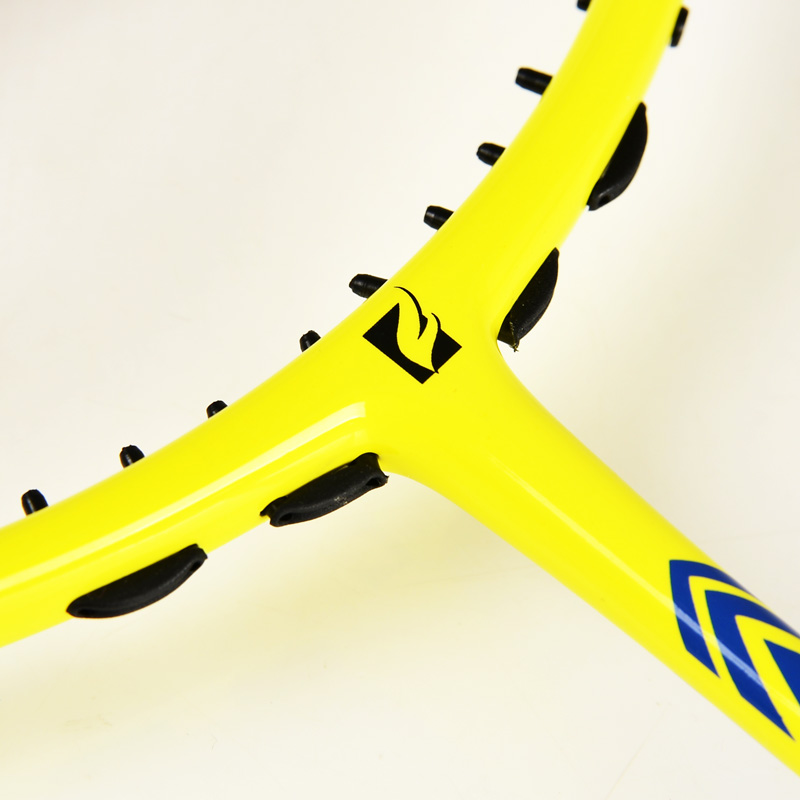
This matters commercially because paint damage is usually excluded from warranty. The customer who chips a frame in week two is not covered, and the review they leave is not about the chip — it is about the finish being thin. Specifying a minimum coat thickness is cheaper than absorbing that reputation.
Check three: colour consistency across the run
The failure that costs the most and gets noticed the least is batch-to-batch colour drift. Two frames from different production lots, both “matte black”, can sit visibly apart on a shelf. This is normal in any coating process and it is manageable — but only if the specification includes a colour tolerance and the inspection includes a comparison against a retained standard sample.
Keep one approved frame from each run. It is the cheapest quality document you will ever hold, and it settles arguments that photographs cannot.
What to put on the purchase order
- Finish type per graphics area, and the clear-coat type over it.
- Gloss level, with a numeric target rather than “matte” or “glossy”.
- Cross-hatch adhesion requirement, stated as a score.
- Minimum coating thickness at the hoop and throat.
- Colour tolerance, plus a retained standard sample per batch.
- Logo method: under the clear coat, or applied over it — the second wears off.
The logo point is the one that generates the most avoidable complaints. A logo printed over the clear coat looks sharper and disappears first. A logo under it survives, but the artwork has to tolerate the coating. Decide which trade you are making before the samples are approved, and write it into the quotation so the cost of the better option is visible rather than absorbed.
For a range, the sensible structure is one gloss line and one matte line, each with a retained standard: the STORM CC6.0 finish and the STORM 90 finish use different surface treatments, and buyers who compare them side by side are really comparing coating systems, not graphics.
Packing, because most paint damage happens in transit
The common assumption is that paint damage comes from play. In practice a large share happens before the racket reaches a customer: frames packed head-to-head in a carton, or shipped in a poly bag with no head protection, arrive with scuffed hoops that a retailer cannot sell at full price.
Specify a head cover or a foam separator per unit, and state the carton configuration. It is a small cost per frame that protects the most visible part of the product — and it is the cheapest way to reduce the credits you will otherwise issue on arrival claims.
What the finish report should contain
Finish reports from factories are usually long and rarely read. Three pages matter: the cross-hatch result, the colour comparison against the retained standard, and the photographs of the approved sample. The rest — gloss readings, film thickness, salt spray — tend to be consulted only after something has gone wrong.
If the factory will only supply one page, take the sample photographs and the colour data. Those two are what allow you to argue “this is not what we approved” on arrival, and without them the argument has no basis.