

Which Squash Ball: Four Dots, Four Rebound Bands
Short answer
The dot on a squash ball is a speed rating, not a prestige grade. Four dots, four speeds, and the fastest ball is the one beginners should use. Pick by speed band and court temperature; never pick by price.
Here is the part almost nobody tells a buyer: the dot is reliable, the spec sheet next to it often is not. Plenty of listings — including, until recently, our own — print one identical rebound figure across every dot colour, which quietly turns four grades into one SKU sold four times. Check the rebound column before you check the dot.
The four grades, with numbers
WSF fixes a naming convention for the speeds and sets construction specifications for exactly two of them. Everything else is manufacturer territory.
| Dot | Speed | Who plays it | Our model | Rebound @ 20 °C |
|---|---|---|---|---|
| Single blue | Fast | Absolute beginners, juniors, school programmes | FCA-07 | 18.5–21.5 in |
| Single red | Medium | Improvers, training sessions, returning players | FCA-48 | 15.5–17.5 in |
| Single yellow | Slow | Club players, regular social matches | FCA-09 | 12.5–14.5 in |
| Double yellow | Super slow | Competition, league and tournament play | FCA-06 | 12.0–14.0 in |
Read the last column downward: the bands step down monotonically, and each step is roughly 2–3 inches. That is what a real four-grade range looks like on paper. If a listing shows the same number in all four rows, it has not graded anything.
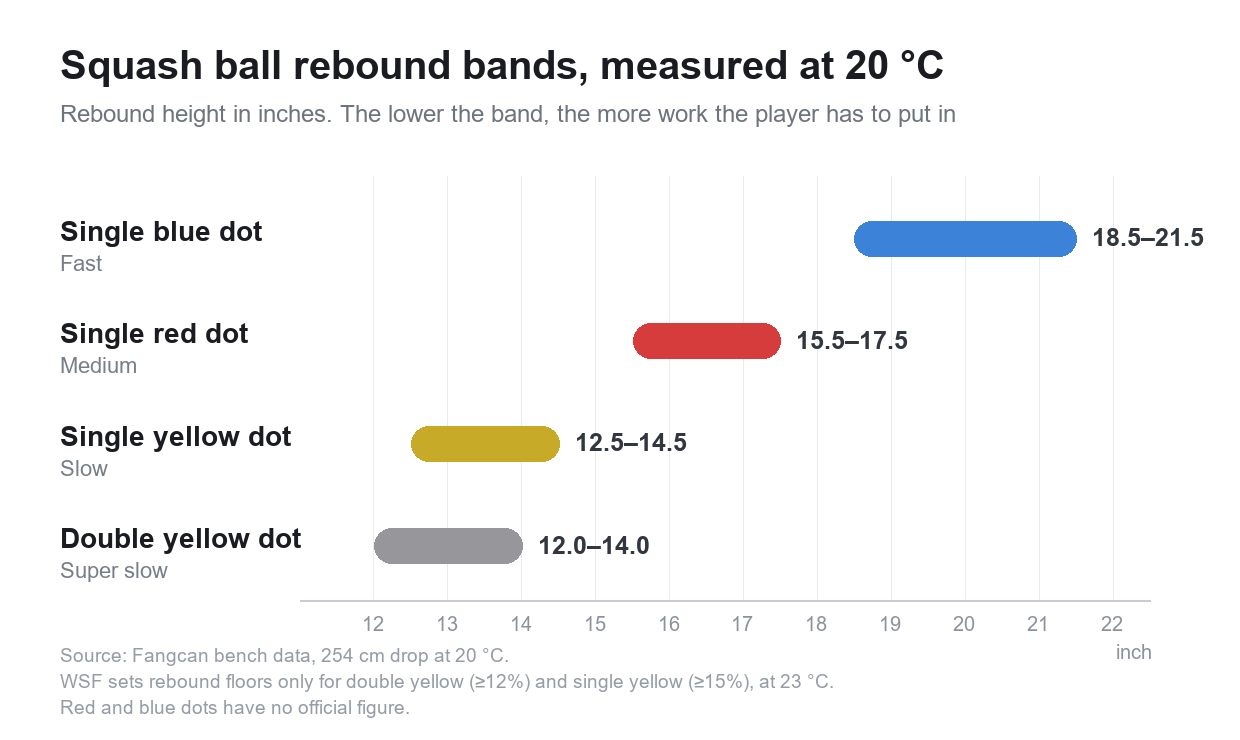
Two of the four have an official number. Two do not.
WSF specifies a standard double yellow dot (competition) ball and a standard single yellow dot (club) ball at 40.0 ± 0.5 mm and 24.0 ± 1.0 g. From a 254 cm drop at 23 °C, the competition ball must return at least 12% of the drop height, the club ball at least 15%.
For anything faster, the document says outright that no specifications are set — such balls may even differ in diameter and weight. So a red dot and a blue dot are conventions, not standards. If a supplier hands you a “WSF figure” for a blue dot, that figure does not exist.
The practical use of that 12% floor: it tells you the direction. A competition ball is required to be the deadest ball, not the liveliest. Any spec sheet that markets a tournament ball as high-rebound has the physics backwards.
Why the slow ball is the good ball
Squash is played inside a box, and the ball only becomes lively once it is warm. Two things follow.
For a beginner, a live ball buys time — time to move, time to get the racket back. A dead ball rewards being already in position before the opponent strikes, which is a description of a good player. Hand a novice a double yellow and the rally ends in three shots; the session teaches nothing.
For an advanced player, a live ball removes the skill. The whole point of tournament squash is that the ball does not sit up for you; you have to create the pace. A blue dot in a league match turns a game of control into a game of waiting.
So the ladder is an effort scale: each grade down asks the player to put more into every shot to keep the rally going. That is why the grading runs backwards compared to almost every other sports category.
Court temperature moves the ball one grade
Squash balls are thermoplastic. The same ball behaves noticeably differently in the first ten minutes on a cold court and half an hour in on a warm one — the pre-match knock-up exists for no other reason.
This has a direct selection rule: in a cold hall, play one grade faster than your level suggests. A club player in an unheated winter hall will get more out of a red dot than a single yellow. In a warm, well-maintained court, the same player can go one grade slower.
It also has an after-sales consequence worth stating on any listing: a customer who opens a box in winter, hits five shots and declares the balls dead has not found a fault. The balls are cold. One sentence explaining this removes a large share of quality complaints at zero cost.
Three steps to picking one
One: count the rally, not the years. How many shots does a typical rally last? Under five, take the blue. Five to ten, red. Ten-plus with control, single yellow. Only if you compete and can keep a slow ball warm for a full game does the double yellow make sense.
Two: check the hall. Cold, draughty, unheated in winter — move one grade faster. Warm and busy — stay or move one slower.
Three: change grade on evidence, not on ambition. The signal to move up is that rallies regularly exceed ten shots and the ball still feels too lively. The signal that you moved up too early is that you are over-hitting and the ball dies in the corners. Both are visible within two sessions.
If you are fitting out a club, a school or a shop
Schools and junior programmes live entirely at the fast end — blue with some red. Anything slower stalls the session.
Clubs split across red and single yellow, with a smaller competition block on double yellow. The competition block is usually overestimated on the shelf and underestimated in turnover: those players buy fewer balls because they play fewer casual games.
Shops most often carry an entry ball and a tournament ball and skip the middle. That leaves every improver choosing between a ball too fast to learn control on and one they cannot keep warm. The red band is the cheapest gap to close, and it is the one that generates repeat purchase fastest — improvers buy consumables every season, competitors buy once.
For how to lay those four grades out against racket tiers and how to price them without building a ladder on dots, see our buyer-side note: dot colours as rebound bands, not a shared register. For why a rebound figure without a temperature is meaningless, see ball tolerances and conditional rebound.
Frequently asked questions
Is a double yellow dot “better” than a blue dot?
No. It is slower. It is the right ball for a strong player and the wrong ball for everyone else. Dot colour rates speed, not quality.
Can I compare two brands by dot colour?
Only loosely. The convention is shared, the execution is not — some brands add white, green or orange dots of their own. Ask for the rebound band and the temperature it was measured at.
What is a white dot?
A slower grade used by some brands, roughly in the single-yellow region. WSF’s own convention list has placed the white and green dots at the slow end. We do not make one, so treat any white dot you meet as “slower than red, check the sheet”.
My ball barely bounces out of the box. Is it faulty?
Almost certainly not — it is cold. Knock it up for a few minutes and measure again. A squash ball is designed to be near-dead at room temperature and only comes alive at working temperature.
How many grades do I actually need to stock?
Four covers most channels. Three is enough for a narrow one, provided the middle grade is one of them.
Want samples across all four grades?
Tell us the market, the court conditions and the player mix, and we will send a sample set covering the four bands with the measured figures attached. Talk to our team.