

Seven Colourways, One Handle: How to Choose a Gradient Overgrip
Seven Colourways, One Handle: How to Choose a Gradient Overgrip
Colour is the only part of an overgrip purchase that has nothing to do with performance, and everything to do with whether you actually enjoy picking the racket up. That is not a small thing. A grip you like looking at is a grip you replace on time.
Our gradient overgrip comes in seven colourways. Here is how each one behaves on the handle, and how to choose between them — for yourself, or for a shop’s shelf.
The seven
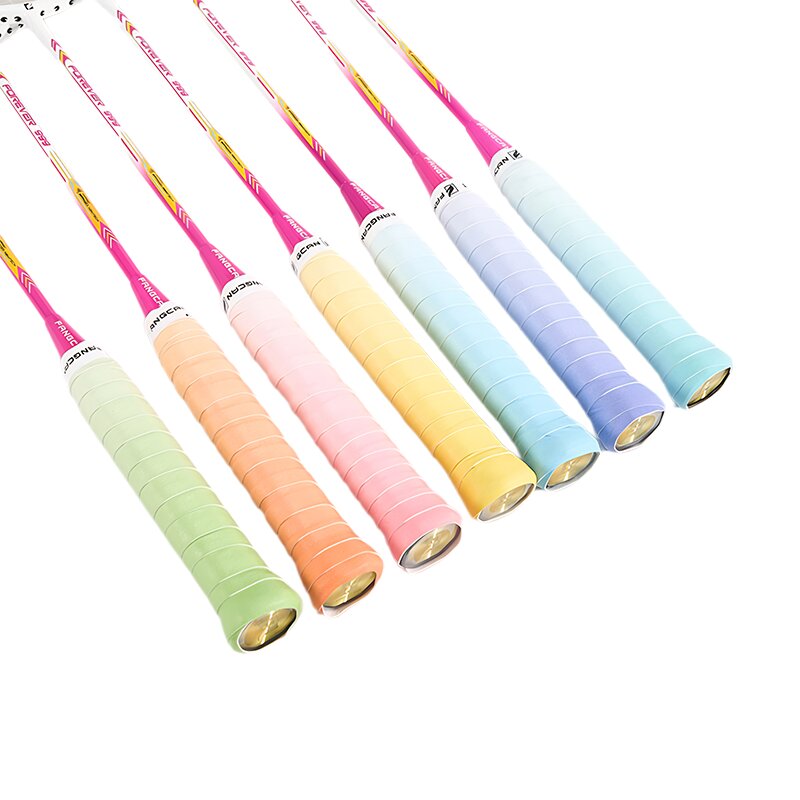
All seven sit in the same tonal family: light, soft, and close in value. That is what makes them work as a set. It is also what makes the differences between them subtle, so the choice comes down to temperature and mood rather than contrast.
| Colourway | Reads as | Best on |
|---|---|---|
| Sakura Pink | Warm, soft, candy-toned | White, silver and pink frames |
| Orange | Warm and energetic, the loudest of the seven | Black and grey frames, where it needs to hold its own |
| Light Yellow | Sunny and clean, closest to a neutral warm | Navy, black, and wood-tone frames |
| Light Green | Fresh and calm, closest to a natural tone | White, black, and green frames |
| Light Blue | Cool and crisp, the safest “clean” choice | Almost anything, especially silver and blue frames |
| Light Purple | Muted and slightly dusky, the most grown-up of the set | Black, white, and purple frames |
| Tiffany Blue | Cool with a mint edge, the most distinctive | Black frames, where the contrast is strongest |
If you only stock one colour, stock Light Blue. It is the one that photographs well, reads as clean rather than cute, and does not clash with a racket bag, a shirt, or a club uniform. It is the lowest-risk choice in the range.
If you want the grip to be the loudest thing on the racket, choose Orange. It is the only one of the seven that holds its own against a dark frame in low light.
The honest part: light colours show wear
All seven are light. That is the point of the range — a pale gradient reads as one soft colour field, and the fade is visible. But light grip tape shows dirt, and hand oils dull the surface faster than they would on black.
Practical consequences:
- On court, a light grip will look tired after roughly two-thirds the playing hours of a dark grip. If you play on dusty courts or in humid halls, expect to replace sooner.
- In a shop, this is not a problem at all — the grip is clean when it is sold, and light colours sell better on a display than dark ones.
- For clubs, if grips are issued and expected to last a full season, a light colour is the wrong pick regardless of how good it looks.
This is not a flaw to hide. If a customer plays four times a week on an outdoor court, tell them the truth: the grip will perform fine, but they will be replacing it more often than they would a black one.
How to choose for yourself
Three questions, in order:
1. What colour is the frame? The grip sits inside the racket’s colour story. A white or silver frame takes almost any of the seven. A dark frame needs a colour with enough separation — Orange, Tiffany Blue, or Light Purple. A brightly coloured frame needs a grip that does not fight it, which usually means Light Blue or Light Yellow.
2. Where do you play? Indoor halls with good lighting flatter the pale tones. Outdoor courts in strong sun wash out Light Yellow and Sakura Pink; the cooler colours hold up better.
3. Does it need to match something else? A club shirt, a bag, a team colour. If so, work backwards from that colour rather than from the frame.
How to choose for a shop or a brand
If you are buying to resell, the question is not “which colour is nicest” but “which mix sells”.
A workable ratio for a first order, based on how colour ranges usually sell in racket accessories:
- Light Blue and Sakura Pink — roughly half the order between them. These are the safe sellers, and they cover the two most common customer preferences.
- Light Green, Light Yellow, Light Purple — the middle ground. Stock enough to fill a display, not enough to sit on.
- Orange and Tiffany Blue — the character colours. Buy fewer, but do buy them: they are what makes the display look like a range rather than a wall of pastels, and they are the ones customers point at.
Two practical notes for retail:
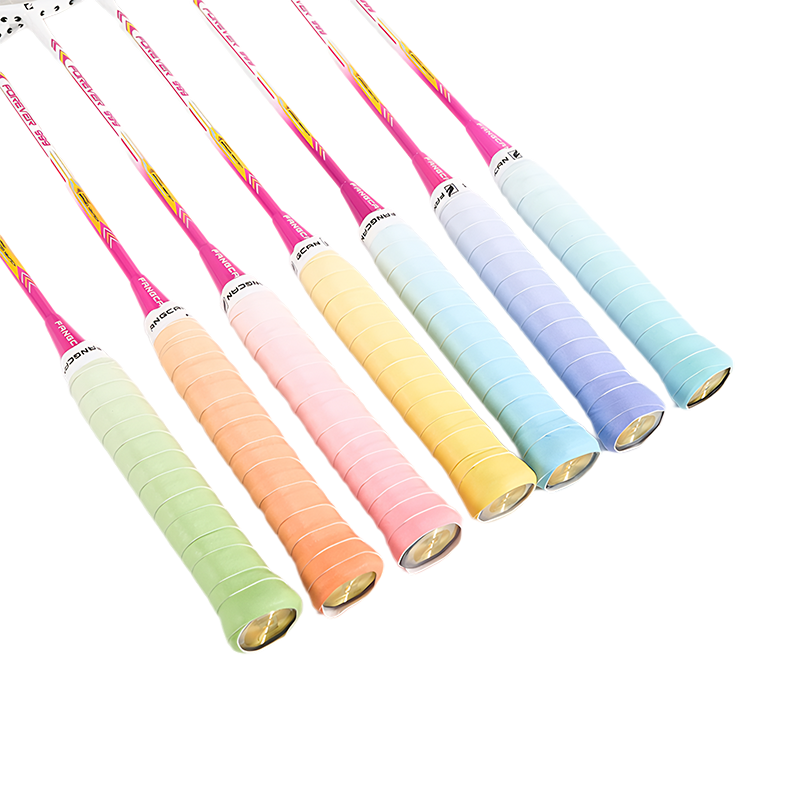
- Display the fade, not the roll. A gradient grip photographed flat looks like a solid colour. Show it wrapped on a handle, or on a strip laid in a wave, where the transition is visible. This single change does more for sell-through than any price adjustment.
- Colour in a photo is not colour on the product. Screens differ, printing differs, and pale tones shift the most. Send physical swatches for any order above sample quantity, and make sure the buyer approves the physical sample, not the screen image.
On colour accuracy, honestly
Pale gradients are the hardest colour family to reproduce consistently — small shifts in a light tone are far more visible than small shifts in a dark one. Two things follow from that:
Between production batches, expect slight variation. If two batches must match exactly — for a team kit, a subscription box, a retail chain — say so at the ordering stage, because that is a production planning question, not a colour question.
Between screen and product, expect a difference. A Tiffany Blue on a phone screen is not the same colour as Tiffany Blue in your hand. This is normal and is not a defect. Approve against a physical sample.
The short version
- Seven colourways, one tonal family — they work as a set because they are close in value.
- Light Blue is the safest single choice; Orange is the loudest; Light Purple is the most subdued.
- Light colours show wear faster. Say so, and recommend accordingly.
- For retail: display the fade wrapped, not flat, and approve colour on a physical swatch.
FANGCAN FCOG-13 comes in all seven colourways listed above — 0.65 mm PU, 1100 × 25 mm, colour-matched finishing tape included. See the range or ask us to produce a colour of your own.