

What Does a Squash Racket’s Weight Actually Mean? Bare, Unstrung and Strung, Explained
Buying a squash racket, the easiest thing to get wrong is not string tension or frame material — it is weight. Not “which weight is better”, but the more basic confusion of seeing three different numbers for one racket: the listing says 200 g, your bathroom of a kitchen scale says 210 g once it arrives, and the label on the frame says 145 g.
Three numbers, one racket. The instinct is that something is mislabelled. In fact all three are correct — they measure the racket in three different states. This article explains what each one means, how they convert, and how to avoid comparing apples to oranges.
The short answer: three conventions, three states of the same racket
Take our squash racket FCSQ-02 (one-piece closed throat). Weigh the same frame in three states and you get:
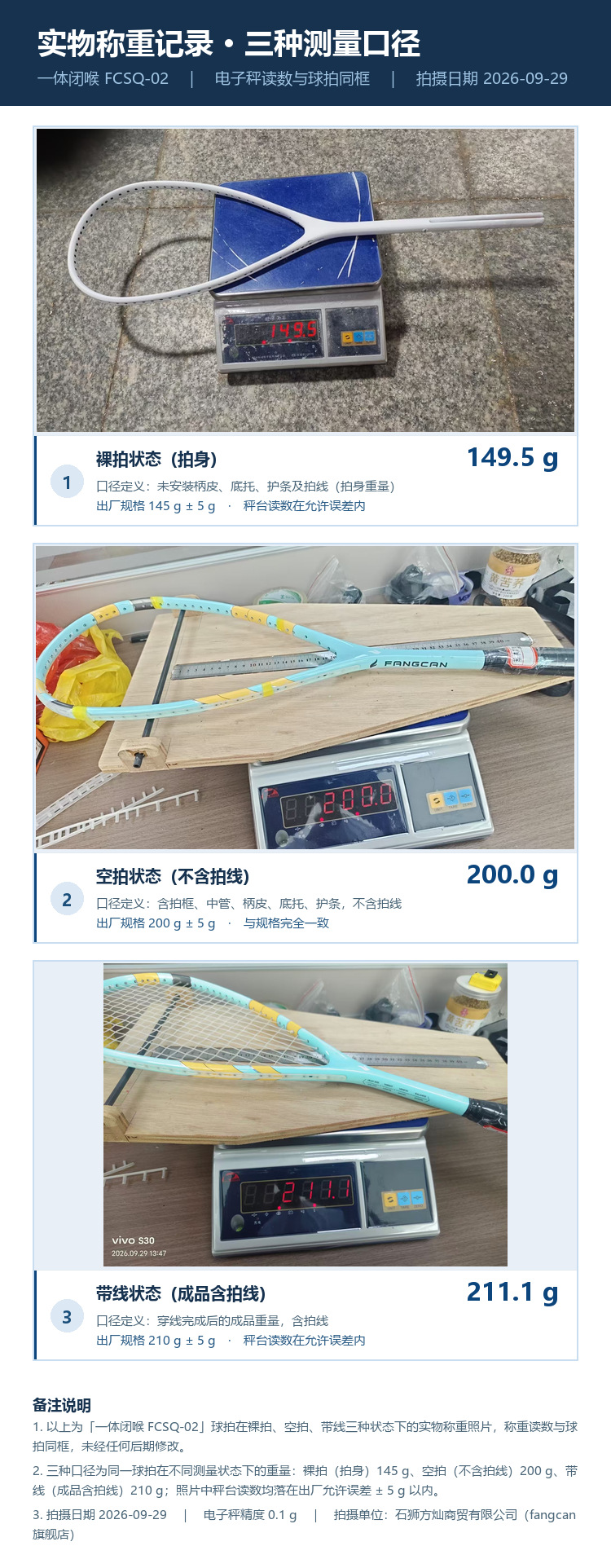
| Convention | What it includes | FCSQ-02 nominal | Where you usually see it |
|---|---|---|---|
| Bare weight | Frame and shaft only — no grip, butt cap, bumper or strings | 145 g ± 5 g | Label on the frame itself |
| Unstrung weight | Frame + shaft + grip + butt cap + bumper, no strings | 200 g ± 5 g | Product page, SKU images (industry default) |
| Strung weight | The finished, strung racket, strings included | 210 g ± 5 g | What you get if you weigh it at home |
From bare to strung, the same racket spans 65 g. That is not a batch difference — it is the difference between measuring states.
Why three conventions exist
It sounds like an excuse. It is not: each convention answers a different question.
- Factories use bare weight. The frame is the core of the product — material, moulding and quality control all centre on it. Bare weight is the cleanest number because it is not disturbed by grip thickness or string choice.
- Industry labels use unstrung weight. This is the standard on racket labels: it counts the grip, butt cap and bumper as standard parts, but leaves out strings, which vary by player. Most brand specs and price comparisons use this.
- Players weigh strung weight. What arrives is a strung racket, so the number on your scale includes strings — a little heavier than the “unstrung” figure on the page.
So a “200 g page, 210 g at home” result is entirely normal. The mistake worth avoiding is comparing a number measured one way with a number measured another.
The conversion: two additions
The three conventions connect through two simple additions:
Bare + parts (grip + butt cap + bumper) ≈ unstrung
Unstrung + strings ≈ strung
With FCSQ-02:
- Bare 145 g + parts of about 55 g ≈ unstrung 200 g
- Unstrung 200 g + strings of about 10 g ≈ strung 210 g
Two rules of thumb: the parts package is usually 30–55 g depending on model and grip, and strings add roughly 10–20 g depending on gauge and tension. A 40–50 g gap between bare and strung is normal.
Where ±5 g comes from
Every figure carries ±5 g. That is a tolerance, not a guess:
- Method: a 0.1 g electronic scale, the same racket weighed three times, arithmetic mean taken.
- Sources of variance: batch differences in carbon and resin content, grip thickness tolerance, and string gauge and tension all move the finished weight within ±5 g.
In other words, a racket marked 200 g is acceptable anywhere from 195 to 205 g; one marked 145 g bare is acceptable from 140 to 150 g. Only a result outside that band is worth questioning.
Full range: compare down a column, not across
Comparing racket weights only means something if both numbers use the same convention and the same method. Here is our full squash range, with all three weights listed:
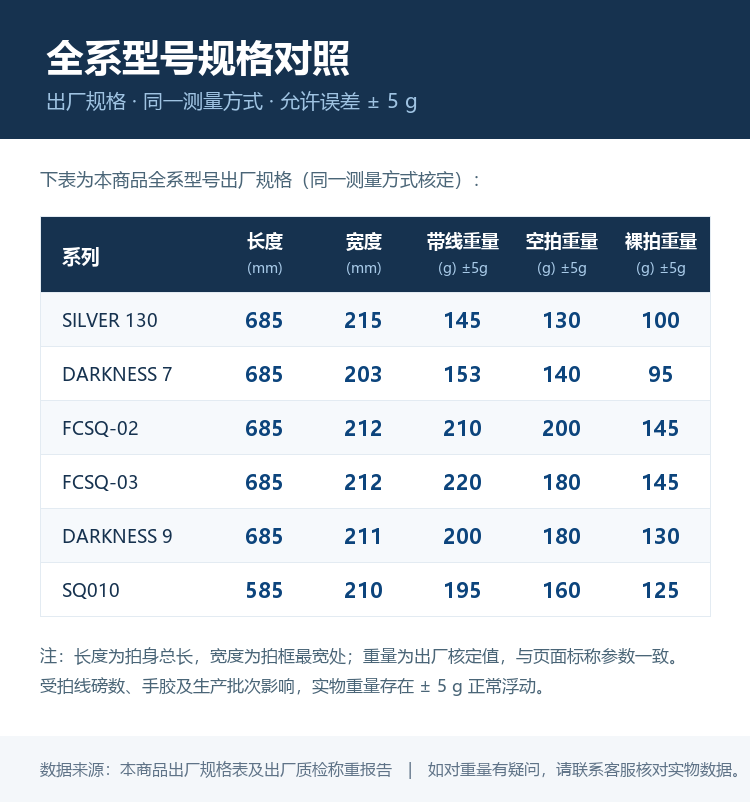
The trick to reading this table: decide which weight you care about, then compare only that column. Take SILVER 130’s strung 145 g and compare it with FCSQ-02’s bare 145 g and they look identical — but one is a finished racket and the other is a bare frame. Compare down a column, never across.
Note: on a couple of models the “strung − unstrung” gap is larger than usual (thicker string or a recording difference); actual product takes precedence. Weight also varies with string tension, grip and production batch, within ±5 g.
How to avoid the mix-up when buying or quoting
- Look for the convention, not just the number. A listing that says “200 g” with no qualifier usually means unstrung (the industry default); weighing it at home will read more, which is normal.
- Match conventions before comparing two rackets. Comparing A’s strung weight with B’s unstrung weight always gives a wrong answer.
- For wholesale or private-label quotes, always state the convention. “200 g” and “210 g” can sit in different cost brackets for a buyer; saying whether it is unstrung or strung prevents a lot of after-sales argument. Different export markets also label differently, so list all three weights in the spec sheet.
The short version
- One squash racket: bare 145 g, unstrung 200 g, strung 210 g — all three correct, three conventions.
- Bare + parts ≈ unstrung; unstrung + strings ≈ strung.
- Every figure carries ±5 g; inside that band, don’t worry.
- To compare weight, compare the same convention first, then the number.
Want a spec sheet that states all three?
We can produce a spec sheet for your model that lists bare, unstrung and strung weight clearly — useful for listings, quotations, or matching different markets’ labelling rules. Get in touch with the model and target market.
Data notes
- Source: factory specification table and factory QC weighing report (report no. FCQC-2026-09-28-001); measured with a 0.1 g electronic scale, same racket weighed three times and averaged.
- FCSQ-02: overall length 685 mm, maximum frame width 212 mm; bare 145 g ± 5 g, unstrung 200 g ± 5 g, strung 210 g ± 5 g.
- Weight varies with string tension, grip and production batch, within ±5 g.