

What Is a Gradient Overgrip? A Straight Answer for Racket Buyers
What Is a Gradient Overgrip?
A gradient overgrip is a racket grip tape whose colour changes gradually along its length — one colour at one end, another at the other end, with a smooth transition in between instead of a hard line.
That is the whole definition. The interesting part is what happens once you wrap it on a handle.
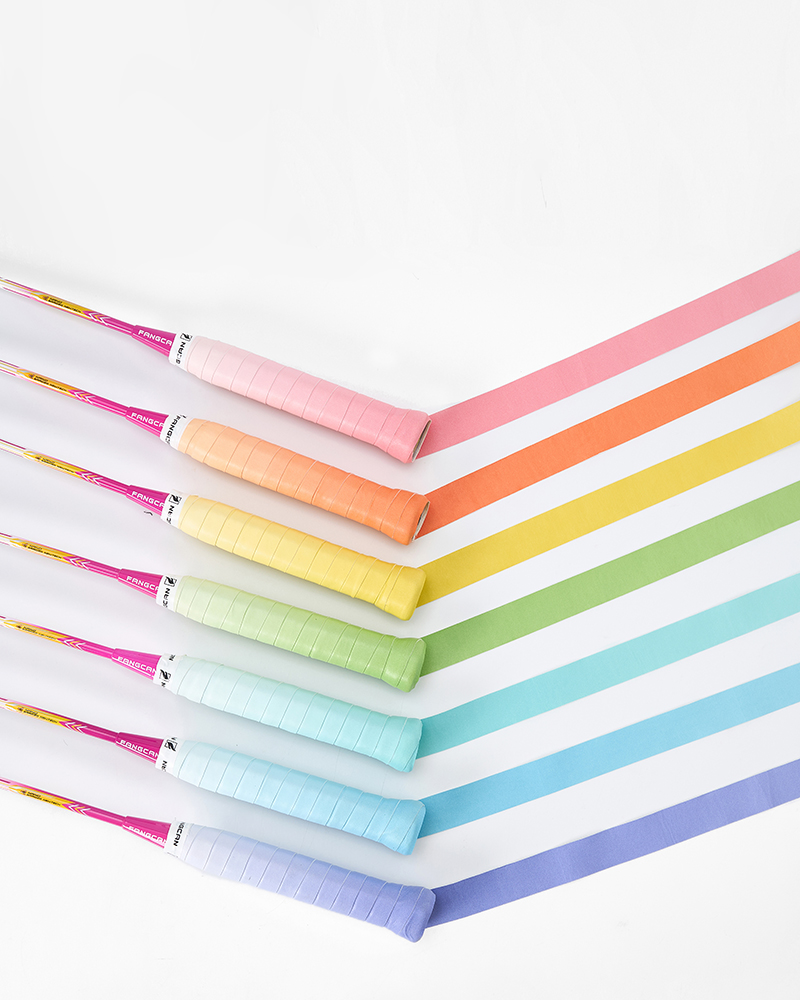
The fade is not what you see on the handle
On the roll, a gradient overgrip looks like a soft colour wash. Wrapped onto a racket handle, it turns into something else entirely: a spiral.
Because grip tape is wound diagonally with each pass overlapping the previous one by roughly half, the lengthwise gradient becomes a series of angled bands that shift colour as they climb the handle. From one side of the grip the colour reads one way; rotate the racket 180° and you see the other end of the fade. Players notice this immediately. It is also why gradient grips photograph so well — every angle gives a different frame.
The visual effect is strongest when the two ends differ in hue, not just in lightness. A white-to-sky-blue fade reads clearly at a glance; a very pale pink to slightly paler pink barely registers from two metres away.
How a gradient overgrip differs from a two-tone grip
These two get confused constantly, and they are not the same product.
| Feature | Gradient overgrip | Two-tone overgrip |
|---|---|---|
| Colour transition | Continuous, no visible boundary | Sharp edge at a fixed point |
| Appearance when wrapped | Spiral bands shifting along the handle | One colour, then the other |
| Best for | Personalisation, retail appeal, brand colour stories | Team kits, club colours, clear split |
| Design flexibility | Any point on the fade can be the “hero” colour | Only two colours exist |
A two-tone grip is a colour decision. A gradient grip is a colour decision plus a wrapping decision — the way you wrap it changes where the transition lands on the handle, so two players using the same grip can end up with noticeably different looks.
What gradient does and does not change
It does not change performance. The colour is on the surface layer. Below it, the material, thickness and adhesive are identical to the same grip in a solid colour. If a grip is 0.65 mm PU with a matte finish, the gradient version is 0.65 mm PU with a matte finish.
It does change perceived value. In retail settings, a gradient grip on a racket reads as a more considered product than the same grip in plain black. That matters if you are a brand buying grips to pair with frames, or a shop building a display.
It is not a replacement for grip quality. A fade cannot rescue a slick surface, a grip that sheds fibres after three sessions, or adhesive that lets go at the tapered end. Judge the grip first, the colour second.
Five specs worth checking before you buy
Most overgrip listings lead with colour and bury the numbers. Check these five before ordering, in this order.
- Material. Polyurethane (PU) is the default for tacky, thin grips. Look for the word explicitly — “PU” or “polyurethane” — not just “synthetic”.
- Thickness. Measured in millimetres, typically 0.5–0.75 mm. Below 0.6 mm you get more direct feel and less cushioning; above 0.7 mm you get more comfort and a slightly larger grip circumference. A 0.65 mm grip is the common middle ground for players who want feel without going bare.
- Dimensions. Width and length. 25 mm × 1100 mm covers a standard badminton handle with enough length for a full wrap plus overlap. Too short and you run out before the taper; too wide and you get ridges.
- Adhesive. Two places matter — the backing adhesive along the tape and the finishing tape at the top. A grip that ships with its own finishing tape is easier to sell as a single unit.
- Colour count. For retail, more colourways per model means fewer SKUs to manage for the same shelf presence. Confirm the colours are actually in stock as separate SKUs, not rendered variations on one photo.
The FCOG-13 reference specification
For a concrete example, here is what our own gradient overgrip looks like on paper:
| Item | Specification |
|---|---|
| Model | FCOG-13 |
| Type | Gradient overgrip (colour-fade), badminton / tennis / squash |
| Material | Polyurethane (PU) |
| Dimensions | 1100 × 25 × 0.65 mm |
| Surface | Matte, slip-free, sweat-absorbing |
| Feel | Soft cushioning, thin profile, skin-friendly |
| Colourways | 7 — Sakura Pink, Orange, Light Yellow, Light Green, Light Blue, Light Purple, Tiffany Blue |
| Finishing tape | Included, colour-matched |
| Customisation | Colours can be produced to your specification |
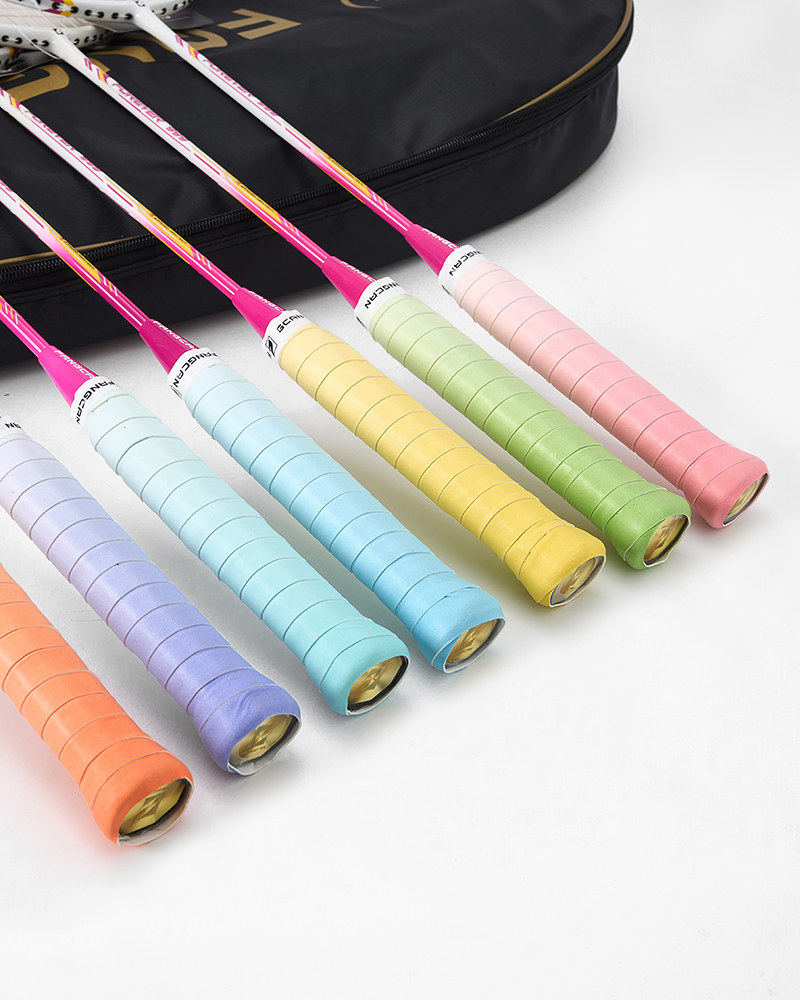
The 7 colourways are not random. They sit in a narrow tonal range — all soft, all light, all readable against both black and white racket frames. That is deliberate: it lets a shop show seven options that look like one family on the shelf, rather than seven unrelated products fighting each other.
How long a gradient grip lasts
A gradient overgrip is a wear item, not a permanent part. The surface layer is what holds both the tack and the colour, so when the grip starts feeling slick, the colour has usually dulled too.
As a working rule, most regular players replace a PU overgrip somewhere between 10 and 20 hours of play — sooner in hot, humid conditions or if you play with a lot of hand tension. Players who chalk or powder their hands will go through grips faster.
Two signs it is time:
- The surface looks polished or shiny where your palm sits, rather than matte.
- You can feel the handle underneath, and the grip no longer returns to shape after you squeeze it.
A gradient grip that has gone slick is not “worn in”. It is worn out.
The short version
- A gradient overgrip = continuous colour fade along the length of a PU grip tape.
- Wrapped on a racket, the fade reads as a spiral — that is the effect people actually see.
- It changes appearance, not performance; judge the grip on material, thickness and adhesive.
- Colour count is a retail decision, not a technical one.
FANGCAN FCOG-13 is a 0.65 mm PU gradient overgrip in seven colourways, made in Shishi, Fujian, China. Colours can be produced to your specification — get in touch with your colour requirement.