

Overgrip Sourcing for Distributors: What Actually Drives Repeat Orders
Ask a distributor why they switched overgrip suppliers and the first answer is usually price. Ask them why they stayed with one, and price rarely comes up. What comes up is that the second batch matched the first, that the colour they needed was actually in stock as a real SKU, and that the grips arrived ready to sell rather than needing to be repackaged.
Overgrips are a commodity on paper: a strip of polyurethane, some adhesive, a finishing tape. In practice they are a repeat-purchase item where consistency compounds. A shop that sells a grip a customer likes will order it again — and that reorder is the entire business. Sourcing decisions should be made with that in mind, which means looking past colour and unit price to the things that decide whether the reorder happens.
Consistency is the product
The single most under-weighted factor in overgrip sourcing is batch-to-batch consistency. A grip’s value is in how it feels in the hand: the tack, the thickness, the way it absorbs sweat and returns to shape. If those drift between production runs, the customer notices — not as “this batch is different”, but as “this grip isn’t as good as it used to be”, and they quietly stop buying.
Three specs carry most of that consistency:
- Material grade. It should be specified as polyurethane (PU), not just “synthetic”. PU is what delivers the tacky, thin, sweat-absorbing feel players expect from a performance overgrip.
- Thickness. Around 0.65 mm is the common middle ground — direct feel without going bare, some cushioning without bulking the handle. Wildly varying thickness between batches reads as a quality problem even when nothing else changed.
- Surface finish. Matte, slip-free, sweat-absorbing. A batch that comes in slightly glossier feels slicker in a humid hall, which is exactly where badminton is played.
A supplier who can hold these three stable across runs is worth more than one who quotes a lower unit price and varies. When you evaluate a sample, evaluate two samples from different batches if you can. The differences, if any, show up there.
SKU discipline: seven colours, not seven products
Colour is where distributors over-complicate their own catalogue. A model offered in seven colourways should read on the shelf as one family — so that a shop can stock the range without managing seven unrelated products.
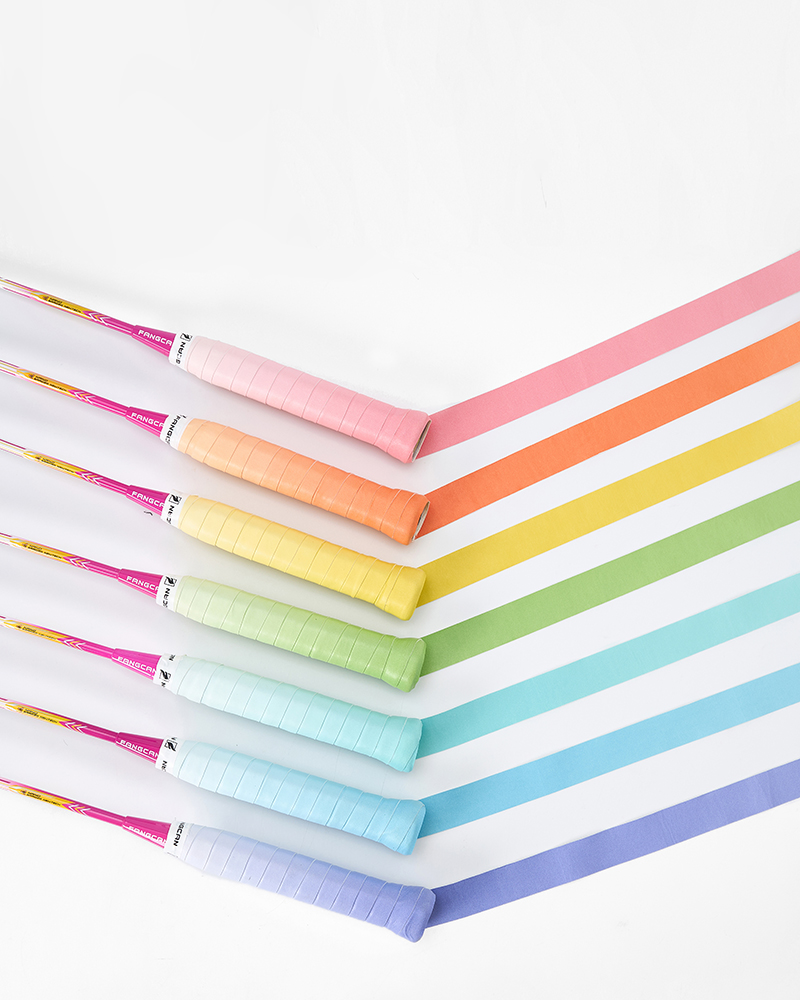
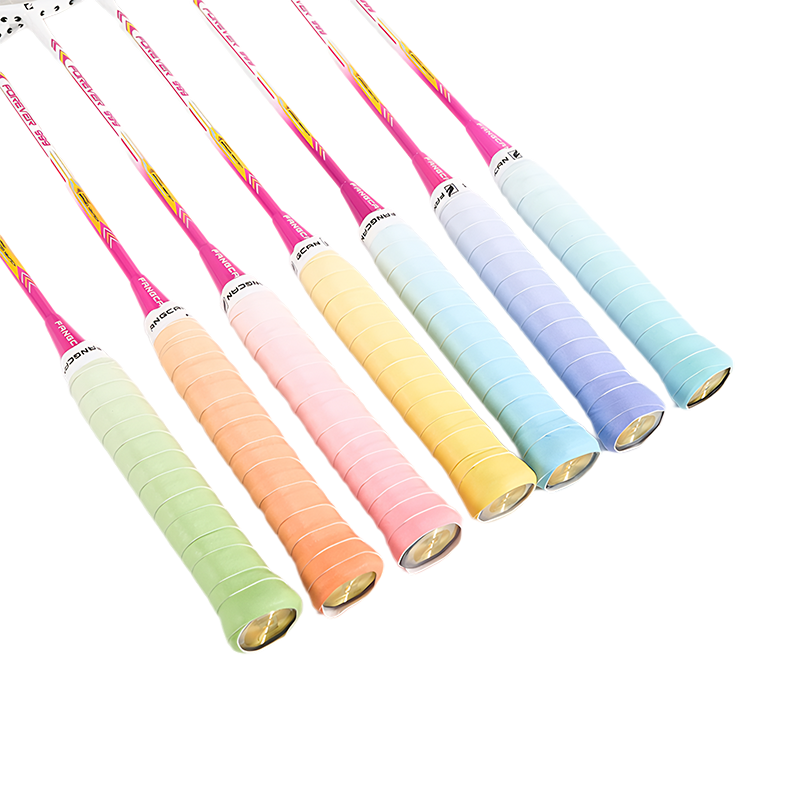
The practical test is whether the colours sit in a coherent tonal range. Our own gradient overgrip, for example, runs seven soft, light shades — Sakura Pink, Orange, Light Yellow, Light Green, Light Blue, Light Purple and Tiffany Blue — all of which read clearly against both black and white racket frames. That coherence is a retail decision: it lets a shop present seven options that look like a set, not a fight.
Two sourcing questions follow from this:
- Are the colours real, separate SKUs with stock — or rendered variations on one photo? Confirm before you commit to a range. A colour that exists only as a filter is a customer-service problem waiting to happen.
- Does the supplier hold the full range, or only the popular two or three? A partial range forces you to either drop colours or split the order across suppliers, both of which erode the “one family” effect you were buying.
Packaging is part of the margin
An overgrip that ships with its own colour-matched finishing tape is a complete retail unit. One that doesn’t forces the shop to pair it with generic tape, which looks improvised and slows the sale. Ask specifically whether the finishing tape is included and colour-matched.
Beyond the tape, packaging affects the buyer’s real cost in two ways. It affects presentation — a grip that arrives looking like a considered product commands a better shelf position than one that looks like a spare part. And it affects handling — well-packed grips don’t arrive with crushed cores or lifted adhesive, which are the defects that turn a reorder into a complaint.
The questions worth asking before you order
A short checklist that separates a supplier you can build a range on from one you can only place a trial order with:
- Will the second batch match the first? Ask how they hold material grade, thickness and finish consistent.
- Is the full colour range in stock as separate SKUs, and can I see them, not just a rendered image?
- Is the finishing tape included and colour-matched?
- What are the actual dimensions? A standard 1100 × 25 mm covers a badminton handle with enough length for a full wrap plus overlap.
- Can colours be produced to specification, and how is that quoted — per project, or off a fixed list?
That last point matters if you are building a private label. Colour customisation is a project conversation, and a supplier who answers it with a fixed catalogue rather than a process is telling you something about their flexibility.
Why this connects to how you sell
Sourcing does not happen in a vacuum. The channel you sell through shapes what “good sourcing” means. On a high-fee, high-discount marketplace, a slightly cheaper grip that generates complaints is a false economy — the return and the review cost more than the saving. (We looked at that cost structure in TikTok Shop vs Shopee: what our own P&L data shows.) And in a market like Malaysia, where platform fees on sports accessories just rose, the margin for sourcing error is thinner than it was. (See what the Shopee Malaysia fee restructure means.)
The through-line: buy on consistency and SKU discipline first, price second. The reorder is where the money is, and the reorder is won before the first shipment leaves.
Source overgrips with the range in mind
We produce PU overgrips — including the FCOG-13 gradient overgrip in seven colourways, 0.65 mm PU, 1100 × 25 mm, with colour-matched finishing tape — and we can produce colours to your specification. If you are building or refreshing an overgrip range and want to talk batch consistency, colour coverage and packaging as one decision, get in touch with your target market and volume.