

Custom Gradient Overgrips: What Brands Can Specify, and What to Send Us
Custom Gradient Overgrips: What Brands Can Specify
An overgrip is one of the cheapest items in a racket sports catalogue and one of the most visible. It is in the player’s hand for every point, it wears out faster than anything else on the racket, and it is the first thing a customer touches in a shop. For a brand, that combination is unusually good value: a small spend per unit, high replacement frequency, and constant physical exposure.
That is why private-label grips are worth doing properly. Here is what a brand can actually specify, and how to run the process without the two things that go wrong most often — a colour that does not match the approved sample, and a first order that arrives with the wrong packaging.
Six things you can specify
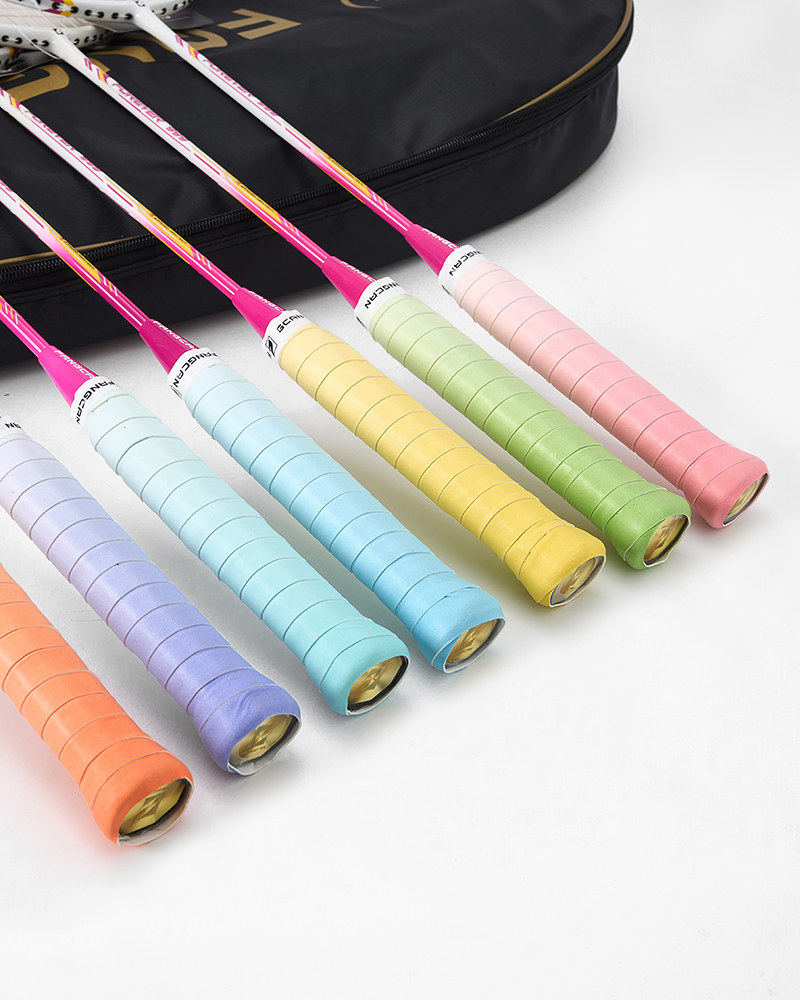
Not every item below is available for every project; the point is to know what to ask about.
- Colour. For a gradient, that means two decisions, not one — the colour at each end of the fade. The transition between them is a production characteristic, not something you draw. Bring a colour reference for both ends.
- Thickness. Typically 0.5–0.75 mm. Thinner means more direct feel, thicker means more cushioning and a slightly larger finished grip circumference.
- Width and length. Governs how the wrap sits and how far it reaches up the handle. If you are supplying a specific racket model, state the model — the wrap length follows from the handle geometry.
- Surface. Matte or glossy, and the degree of tack. Worth deciding explicitly rather than assuming: tack is the single attribute players comment on most.
- Finishing tape and closure. Colour-matched, printed, or plain. A grip that arrives with its own matching tape is a better retail unit than one that needs separate tape.
- Packaging and labelling. Header card, poly bag, printed sleeve, barcode, hang tag, multi-packs. This is where most first-order problems happen, because packaging is usually agreed verbally and confirmed late.
The seventh thing, which is not a specification
Language on the product. If the grip carries any printed text — a sleeve, a header card, a hang tag — decide the language and the wording before production, and approve a proof. Text on packaging is the item that most often blocks a delivery, because it is the last thing anyone thinks to check and the first thing a buyer inspects.
How colour approval should work
Pale gradient colours are the hardest family to match, because a small shift in a light tone is far more visible than the same shift in a dark tone. Handle approval in this order:
- Give a reference. A Pantone number, a physical swatch, or a competitor product. A screen image alone is not a reference — it will not be the same colour on a different display.
- Approve on a physical sample. Not a photo of a sample. Photograph a pale grip in two different light conditions and you get two different colours; both are “true”.
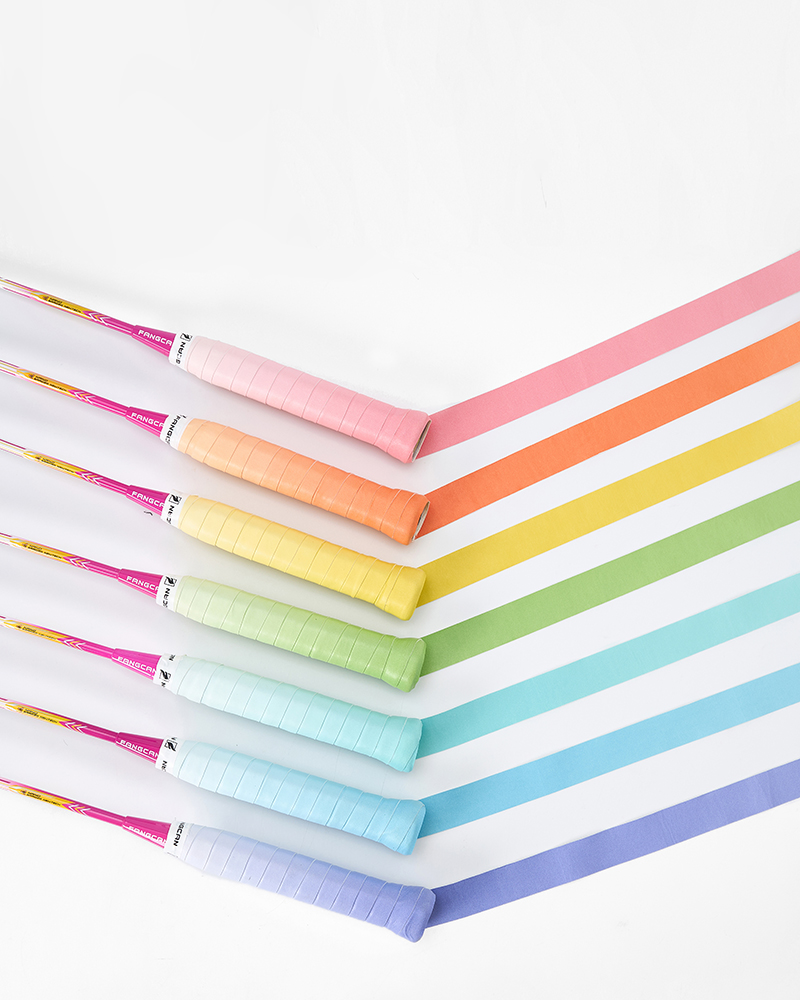
- Check the whole roll, not one end. This is specific to gradients: the two ends can each be right while the transition between them runs too fast or too slow, making the grip look two-tone rather than gradient. Look at the tape laid out along its full length before you approve it.
- Record what was approved. Keep the signed-off sample and the colour reference with the order. When a repeat order is placed, that record is the brief.
If a client needs two batches to match exactly — for a club kit, a retail chain, a subscription programme — say so before production is planned, not after. Batch-to-batch consistency is a planning question.
Minimum order and lead time
Both depend on the project, and neither should be quoted before the specification is clear. They move with:
- the number of colourways in the order (each colourway is a separate production run)
- the packaging format (a printed header card carries its own setup)
- whether a new sample has to be developed
The honest answer to “what is your MOQ” is therefore: tell us the colours, the quantity split across those colours, and the packaging, and the number becomes meaningful. A question with no specification gets a number that either scares the buyer away or cannot be held.
The same applies to lead time. Sampling and mass production are two separate schedules, and the sampling stage is the one that slips, because it involves your approval cycle as well as ours. Plan for both.
How to write a first enquiry that gets a useful reply
A first email that contains these seven points will get you a real quotation instead of a price range:
- Product type — gradient overgrip, and whether you want a specific fade or a free choice.
- Colour reference — for gradients, both ends. Pantone, physical swatch, or a product you are matching.
- Specification — thickness, width, length, surface finish. If you do not know, say which racket model it is for.
- Quantity — total, and how it splits across colourways.
- Packaging — format, and whether it needs your logo, barcode, or a specific language.
- Destination market — country, and whether the product needs specific labelling for that market.
- Timing — when you need the goods in hand, not when you want to order.
Point 6 and point 7 are the ones buyers leave out and then complain about. A labelling requirement discovered at the port is expensive; a delivery date discovered to be two weeks earlier than planned is worse.
What to check when the goods arrive
A short, practical inspection list for a first shipment:
- Colour against the approved sample, in daylight, not under warehouse lighting.
- The fade along the full length of several rolls — check the transition, not just the ends.
- Thickness with a caliper at three points per roll. Thin spots are a manufacturing defect, not a tolerance.
- Adhesive — peel back the film on one roll and confirm it holds without leaving residue on the backing.
- The finishing tape is present, colour-matched, and actually adheres to the grip surface.
- Packaging — barcode scans, language is correct, count per carton matches the packing list.
None of this requires a lab. It requires an hour and the approved sample next to you.
Why gradient, specifically
Most private-label grip ranges are solid colours, because solid colours are the easy option. That is also why they are the crowded option: a buyer comparing three suppliers’ catalogues sees three sets of black, white, blue and red.
A gradient grip is harder to source and easier to remember. For a brand building a small accessory line alongside frames, it does more work per unit than another solid colour — it shows in photographs, it reads as a designed product rather than a commodity, and it gives a shop something to put at the front of the display.
It also pairs naturally with the frame’s colour story, which is exactly the kind of detail that makes an accessory look like part of a range instead of an afterthought.
FANGCAN produces PU overgrips in Shishi, Fujian, China, including the FCOG-13 gradient overgrip in seven colourways. Colours can be produced to your specification. To start a project, send us your specification — the seven points above are enough for a real quotation.