

Badminton Racket Market 2026: Size and Material Trends
The global badminton racket market was valued at USD 2.02 billion in 2026 and is projected to reach USD 3.16 billion by 2034, a 5.74% CAGR. Asia-Pacific alone accounts for 40% of it. More interesting for manufacturers than the headline number is what sits underneath: which frame material buyers are actually choosing, and where the growth is concentrated.
The headline numbers
The badminton racket market was valued at USD 1.91 billion in 2025 and is projected at USD 2.02 billion for 2026, reaching USD 3.16 billion by 2034 at a 5.74% CAGR over 2026–2034. Asia-Pacific is both the largest and the fastest-growing region, holding roughly 40% of global demand in 2025 and forecast to expand from USD 1.4 billion to USD 2.2 billion by 2033.
These are third-party forecast figures, and forecasts move. They are useful as a directional anchor rather than a precise number, and any manufacturer quoting them should cite the source rather than presenting them as measured data.
Where growth actually comes from
Three drivers account for most of the projected expansion, and they matter differently to a factory.
Rising participation at the recreational level. The growth in registered players and club participation creates a steady replacement and upgrade cycle. Every new player needs a racket; many existing players upgrade within two to three years. This is the most reliable volume driver and it favours entry- and mid-price segments over elite equipment.
Health and fitness awareness. Badminton is comparatively cheap, easy to schedule and delivers cardiovascular, agility and reflex benefits. Public health campaigns and government sport-participation initiatives in developing economies are adding to the participant base across multiple price segments.
Material and design innovation. Advanced carbon fiber composites and other lightweight, high-strength materials keep expanding what is possible in frame design, and fuel replacement demand among performance-oriented players.
The material shift is the part worth watching
The single most consequential structural change for manufacturers is not volume. It is the composition of what gets sold.
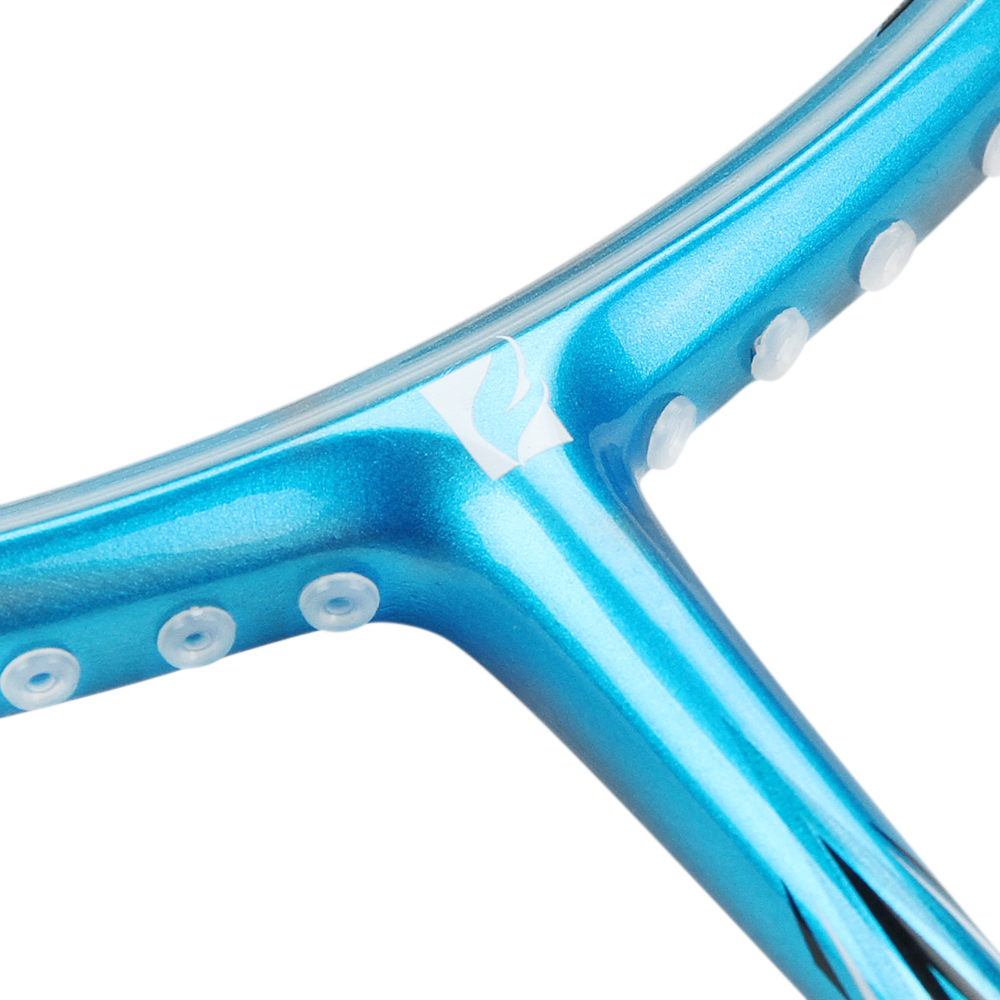
Graphite, carbon and aluminium rackets are treated as distinct product types in market segmentation, and the growth is unevenly distributed across them. Full-carbon frames have moved from specialist positioning into mainstream catalogue range, driven by falling material cost and improved process capability. Within carbon frames, grade differentiation has become a selling point in its own right — high-modulus grades such as T700 are specified explicitly on an increasing share of product listings, where buyers who cannot yet afford an established premium brand want a credible technical claim.
For factories, this creates a specific operational requirement: being able to produce across material tiers from the same line, with documented frame specifications, rather than committing to a single material. Buyers increasingly compare across categories, and a supplier that can only quote one material effectively competes with only one segment.
Online has become the primary distribution channel
E-commerce is identified as the largest segment of badminton racket distribution and a primary growth driver. For Asian manufacturers this is the more consequential half of the finding: the channel that is growing fastest is the one where the buyer can compare specifications directly, where price transparency is highest, and where a supplier’s quality claims have to survive being read by someone else in the same category.
What a manufacturer should take from this
- Plan across material tiers, not inside one. Capability to offer graphite, carbon composite and full carbon from the same production base widens the addressable customer set.
- Document the specification, do not just claim it. Frame composition, shaft grade, weight class and balance point are becoming comparison points. Buyers use them to justify a price difference.
- Treat regional growth as a route to market, not just a statistic. Asia-Pacific concentration means competitors in the same region, and regional buyers compare manufacturing terms directly.
- Do not build a forecast into pricing. Use the direction, keep the modelling flexible.
Plan your next buying cycle with us
The market is growing at a moderate, believable rate, and the differentiation is moving toward the specification sheet. If you are a racket manufacturer looking at what to put in a product line for the next buying cycle, tell us which material tier and market you are targeting and we will send a capability and specification outline.
Sources
- Value Market Research, “Global Badminton Racket Market Size, Share, Trends & Growth Analysis Report”, 2026–2034 — valuemarketresearch.com
- Accio, “trending badminton rackets 2026” — accio.com