

Fiberglass vs T700 Carbon Pickleball Paddles: The Two Dimensions That Decide the Sale
Pickleball paddle buyers tend to open with the same question: fibreglass or carbon. It is the right question asked in the wrong place, because the two paddles in our range differ in ways a spec sheet settles faster than any material claim — length, handle length, and what actually ships in the box.
Two paddles, and where the difference really sits
| Spec | T700 carbon | Fibreglass set |
|---|---|---|
| Weight | 210 ± 5 g | 215 ± 5 g |
| Overall length | 420 mm / 16.5 in | 400 mm / 15.8 in |
| Core thickness | 16 mm | 16 mm |
| Handle length | 140 mm / 5.51 in | 125 mm / 4.92 in |
| Grip circumference | 10.80 cm / 4.25 in | Not specified |
| Box contents | 1 paddle + 2 overgrips | 2 paddles + 4 balls + bag |
The core matches. Weight differs by five grams. Length differs by twenty millimetres, handle by fifteen. Two conclusions follow: the playing difference comes from the face material and the length rather than the core, and these two products were never competing for the same shelf space — one is a single-paddle gift box, the other a two-person starter kit.
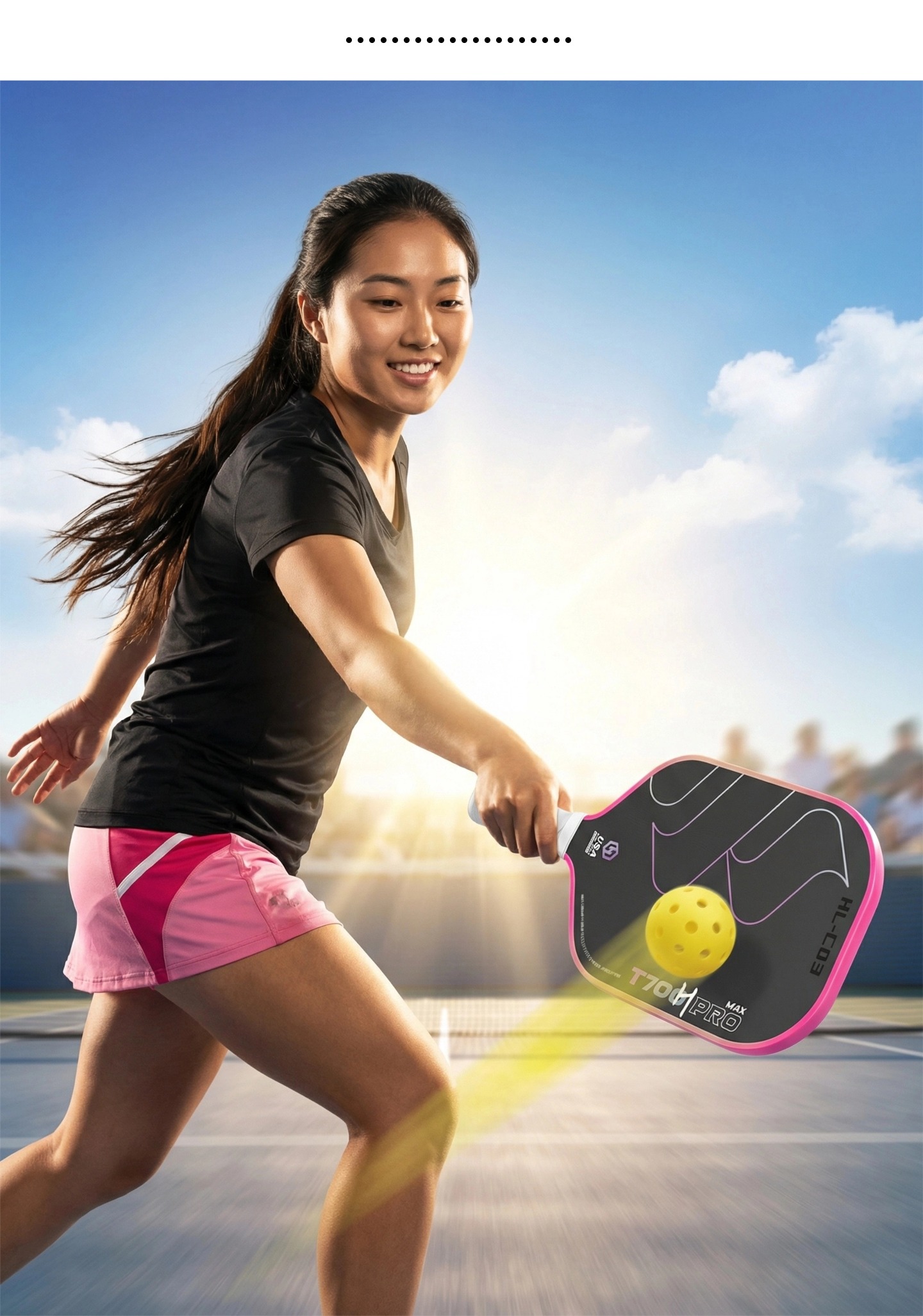
The T700 sells length and repeatability, not the word carbon
420 mm overall, a 140 mm handle and a 4.25 inch grip circumference point at one job: blocking at the net and resetting quickly. The longer handle gives both hands room and pushes the sweet spot upward. A T700 face deforms less at contact, so the ball leaves closer to where you aimed.
That rigidity is also the cost. A stiff face forgives less on mishits and tells you immediately when you miss; at 210 g it is not a paddle you want in a long rally while your technique is still forming. It belongs to players six months in, who care about placement rather than simply clearing the net.
As a retail object it ships as a single-paddle gift box with two overgrips. That makes it a gifting and upgrade item with a healthy unit price, and it produces no attachment sales — balls and bags are bought separately.
The fibreglass set sells “two people can play today”
400 mm, a 125 mm handle, 215 g. On paper it is the conservative build. A fibreglass face deforms more, trading some ball speed for forgiveness — hit slightly off centre and the ball still travels. For two people on a court for the first time, that matters more than any material argument.
The real advantage is not the paddle. It is the contents: two paddles, four balls, a bag. The most common barrier to entry in pickleball is not paddle price, it is buying two paddles and discovering there are no balls. Packing balls and a bag into the box shortens the conversion path to a single click and removes half the reasons a first order comes back.
The trade-off is a lower unit price, and balls inside the set are consumables — when they wear out, the customer returns for balls, not for paddles. Stock them as separate lines: paddles and bags by the set, balls by the piece.
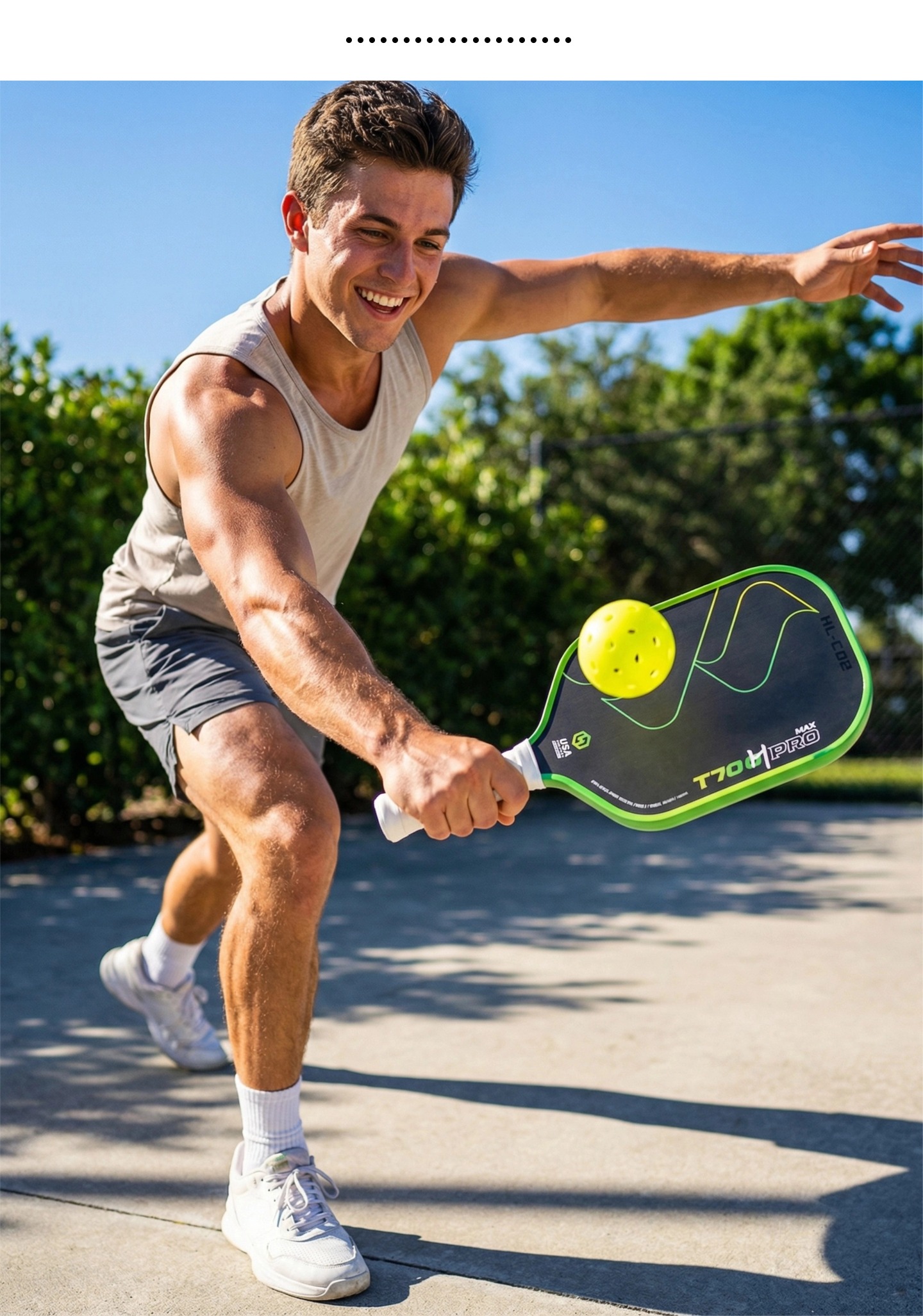
How to plan the buy: by scenario, not by material
Channel sets the mix. Specialist sports retailers and clubs can carry a higher share of the single box, because people walking in already know what they want. Supermarkets, marketplaces and gifting channels move sets far better — the buyer wants one purchasable thing that works.
Do not build the price ladder on material alone. Two paddles with the same core and near-identical weight are hard to defend on face material when a buyer is comparing prices. Length, handle, sweet-spot coverage and box contents are the differences a customer can verify without trusting you.
Keep balls as their own SKU. The balls inside the set have their own reorder rhythm. Manage them separately or the set gets broken up because the balls ran out.
Check grip circumference. 4.25 inches is on the slim side — suited to smaller hands and players who like a thin overgrip. For markets with larger hands, a thicker overgrip closes the gap without changing model; the arithmetic behind that is in grip thickness versus grip size.
Frequently asked questions
Is carbon always better than fibreglass?
It is different, not better. Carbon deforms less, holds placement, forgives less. Fibreglass deforms more, forgives more, delivers slightly less speed. The player decides, not the price.
Is a 16 mm core standard?
16 mm is the common middle: reasonable power, reasonable control. Thicker cores lean toward power, thinner toward control, but that spread is smaller than what face material and length produce.
What happens when the balls in the set wear out?
Stock balls separately. Pickleball balls wear faster than most first-time buyers expect, and a stock-out sends them to another brand.
Should the single paddle ship with a bag?
Only on request. Buyers of the single box usually already own one.
Want a stocking plan for pickleball paddles?
If you are deciding how many models to carry and how to split singles against sets, tell us your channels and customer base and we will return a combination you can order directly, built from length, handle and box structure. Talk to our team.