

Aluminium-Composite vs Full Carbon Squash Rackets: What 85 Grams Decides
Grading squash rackets by material is the convenient route: aluminium-composite for entry, full carbon for professionals. The conclusion holds, but it hides what a buyer actually has to decide. Between a 230 g frame and a 130 g frame there is not a material gap. There is a customer gap, a freight gap and a service gap.
Four frames, three numbers that matter
| Spec | FCSQ-01 | FCSQ-02 | SILVER130 | DARKNESS 7 |
|---|---|---|---|---|
| Material | Carbon + aluminium | Carbon + aluminium | 100% carbon | Ultra H.M. graphite |
| Weight (unstrung) | 230 ± 5 g | 198 ± 5 g | 130 ± 5 g | 145 ± 5 g |
| Head size | 76 sq.in | 74 sq.in | 76 sq.in | 78 sq.in |
| Balance | 335 ± 7 mm | 370 ± 5 mm | 380 ± 4 mm | 365 ± 5 mm |
| String pattern | 19 × 14 | 14 × 18 | 14 × 18 | 19 × 12 |
| Max tension | ≤ 26 lbs | ≤ 26 lbs | Not specified | ≤ 35 lbs |
| Level | Entry | Entry | Professional | Professional |
| Cover | 3/4 cover | 3/4 cover | Full cover | Full cover |
Three numbers decide the commercial outcome: weight, tension ceiling, cover format. Material is the explanation for why those three differ — not a selling point in itself.
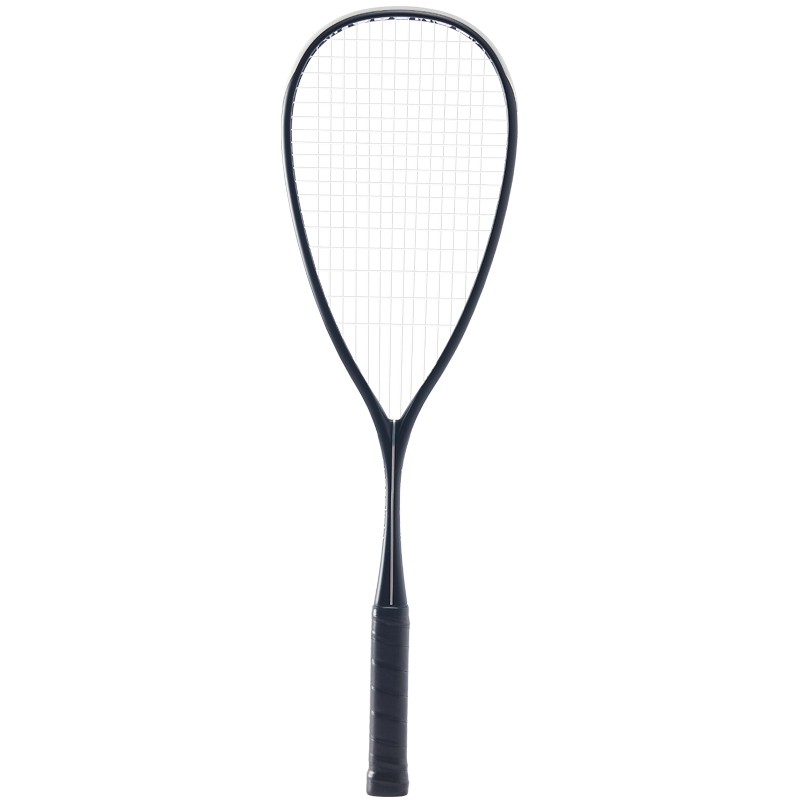
One: 85 to 100 grams separates two groups of people
Between 230 g and 130 g the difference is immediately obvious in the hand. It decides whether a twelve-year-old can swing the frame for forty minutes, and whether an adult improver finds it heavy by the second game. The aluminium-composite pair lands at 198–230 g, the full carbon pair at 130–145 g, and the middle is empty. That gap is not a hole in the range — it is the natural distance between two customer curves.
Two purchasing consequences. First, no single frame covers the whole market: hand a beginner a full carbon frame and the swing speed never arrives, so the ball never does; hand an advanced player a 230 g frame and the arm goes after half an hour. Second, weight is freight: air and express rates run on actual or volumetric weight, and four 230 g frames weigh roughly 400 g more than four 130 g frames. Across a shipment that difference removes several points of margin.
Two: the tension ceiling decides whether you can sell stringing
Both aluminium-composite frames are rated to 26 lbs. The DARKNESS 7 is rated to 35. For retail this matters more than feel: if your shop or club strings rackets, the ceiling is the boundary of what you can service. A customer arriving with an entry frame and asking for 30 lbs leaves you two bad options — refuse, or risk the frame.
It is also a natural basis for graded selling. Entry frames pair with strings whose own ceiling sits below 26 lbs; only advanced frames justify high-tension string. Frame and string ratings have to agree, exactly as they do in badminton.
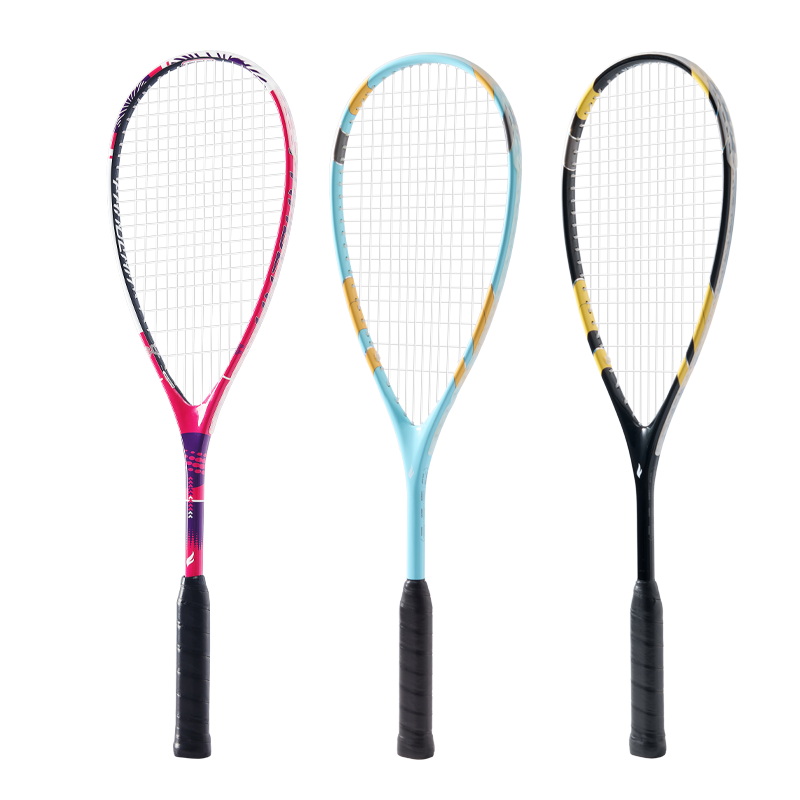
Three: the cover format moves your return rate
Entry frames ship with a 3/4 cover, professional frames with a full cover. It reads like packaging detail, but it changes how complete the product feels on arrival. First-time buyers rarely own a separate bag, and a 3/4 cover protects the head but not the shaft — a frame that arrives with a mark on the shaft comes back described as a defective product.
For entry frames sold online, add a protective layer inside the carton or offer the bag as an add-on. The cost is small and it removes a category of returns that should never happen. It is also the reason entry and professional frames deserve separate operational treatment: different customers, different failure points.
Planning the buy: cut by customer curve, not by material
Set the customer mix first. Squash demand is pyramidal — entry and intermediate carry the volume, professional sits on top. If your customers are mostly casual court bookings and school programmes, the two composite frames should be the volume lines and one carbon frame each for halo and upgrade path.
Split FCSQ-01 from FCSQ-02 by player, not by price. Both are carbon-aluminium, but they point in different directions: the 01 is heavier at 230 g with a 335 mm balance and a 76 sq.in head; the 02 is lighter at 198 g with a 370 mm balance and a 74 sq.in head. The first suits adult beginners who want stability, the second suits smaller hands and lower strength. Treat them as two customers, not two price points.
Position the two carbon frames apart. The SILVER130 is 100% carbon, 14×18, 130 g; the DARKNESS 7 is ultra high modulus graphite, 19×12, 145 g, ceiling 35 lbs. String pattern density changes feel more than the weight difference does — which is why two frames at the same level still need to be sold by playing style rather than by price order.
Do not put a price table in the article. Explaining the pairing logic — entry balls with entry frames, tournament balls with professional frames — converts better than listing numbers, because the customer comparing suppliers compares configurations, not figures.
Frequently asked questions
Is aluminium-composite just a cheap version?
No. It is a different engineering trade: aluminium adds frame stiffness and lowers cost, and weight is what you pay. For beginners, that weight reads as stability.
Is a 130 g full carbon frame suitable for a beginner?
Usually not. A light frame needs faster swing speed to produce pace; beginners cannot generate it and conclude the racket is dead.
Is 26 lbs enough?
For entry and intermediate players, yes. Only advanced customers needing high tension reach that line, and those customers belong on the carbon frames anyway.
Can covers be sold separately?
Yes, and they should be. A cover is a low-price, repeat-purchase accessory; managed as its own SKU it is far more flexible than bundled into the frame.
Want a grading plan for squash rackets?
If you are setting the model structure — how much entry against professional, and how the two composite frames split the customer base — send us your market and customer mix and we will return a combination built on weight, balance and tension ceiling. Talk to our team.