

Badminton String Gauge: Ranking 0.66 to 0.72 mm for Buyers
String gauge is the one spec on a badminton string that buyers read first and understand least. The usual assumption is that 0.66 mm sits above 0.72 mm on some quality ladder. It does not. It sits in a different job — and the number that actually constrains what you can sell is not the diameter at all.
Five strings, five gauges, and a pattern that does not hold
Put our own range side by side and the expected progression falls apart:
| Model | Gauge | Max tension | Sells on |
|---|---|---|---|
| BG66 | 0.66 mm | 22–24 lbs | Feel |
| BG95 | 0.68 mm | 26–30 lbs | High tension |
| BG85 | 0.69 mm | 26–28 lbs | Durability |
| BG2009 | 0.69 mm | 26–30 lbs | High tension |
| BG2006 | 0.72 mm | 22–26 lbs | Durability |
If diameter were the only variable, the thinnest string would hold the least tension and the thickest the most. Instead the thinnest tops out at 24 lbs, the thickest at 26 lbs, and a 0.68 mm string in the middle reaches 30 lbs. Maximum tension comes from core structure and outer wrap as much as from cross-section, so you cannot read it off the gauge.
The purchasing consequence is blunt: gauge ranks customers, not products.
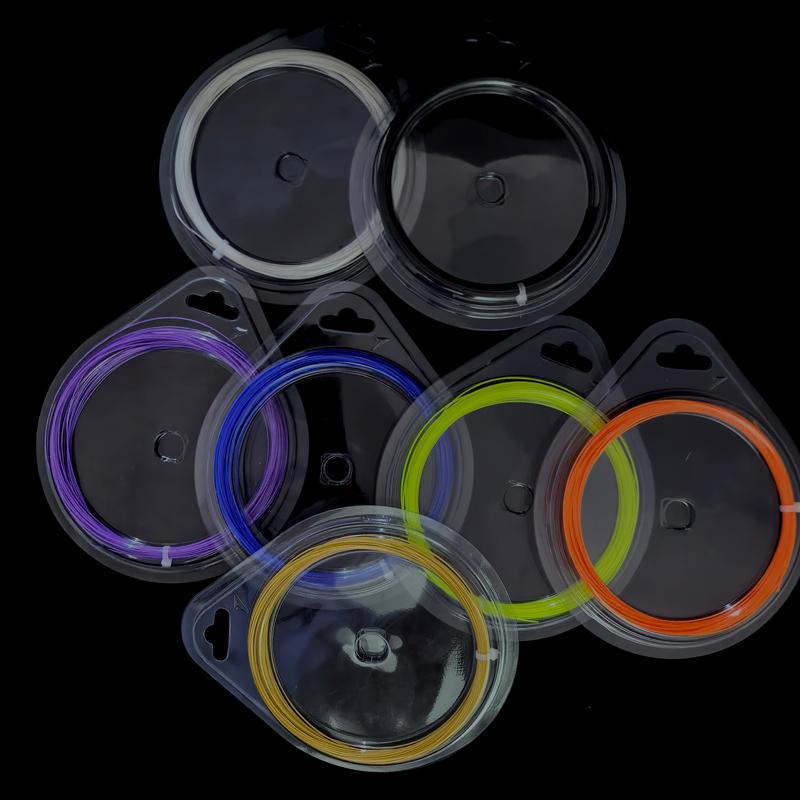
Thin strings sell feel; thick strings sell fewer complaints
A 0.66 mm string earns its price at the moment of contact — more deformation, faster snap-back, a sharper sound, clearer feedback. It suits players whose technique is settled and who will pay for that feedback. The cost is equally clear: under the same tension a thinner string carries higher stress per unit of cross-section, so it breaks sooner, and its own ceiling of 24 lbs means it cannot serve the high-tension half of the market at all.
A 0.72 mm string does the opposite job. It tolerates rough stringing, frequent mishits and long replacement intervals — the profile of a training hall, a school programme or a club where one racket plays ten sessions a day. Slow wear, few complaints, no one praising the feel.
The 0.68–0.69 mm band is where most of the volume sits, provided your customer base includes both improving players and institutional buyers. Its real advantage is not balance. It is that one string can serve two segments, which keeps your SKU count down.
The order of decisions: customer, then width, then colour
First, who plays. Entry and intermediate players are served by 0.68–0.72 mm; keep a single thin model as a halo product. Advanced and semi-competitive players need the 0.66 mm class, because it is the fastest-repeating consumable you stock — it breaks, so it is bought again.
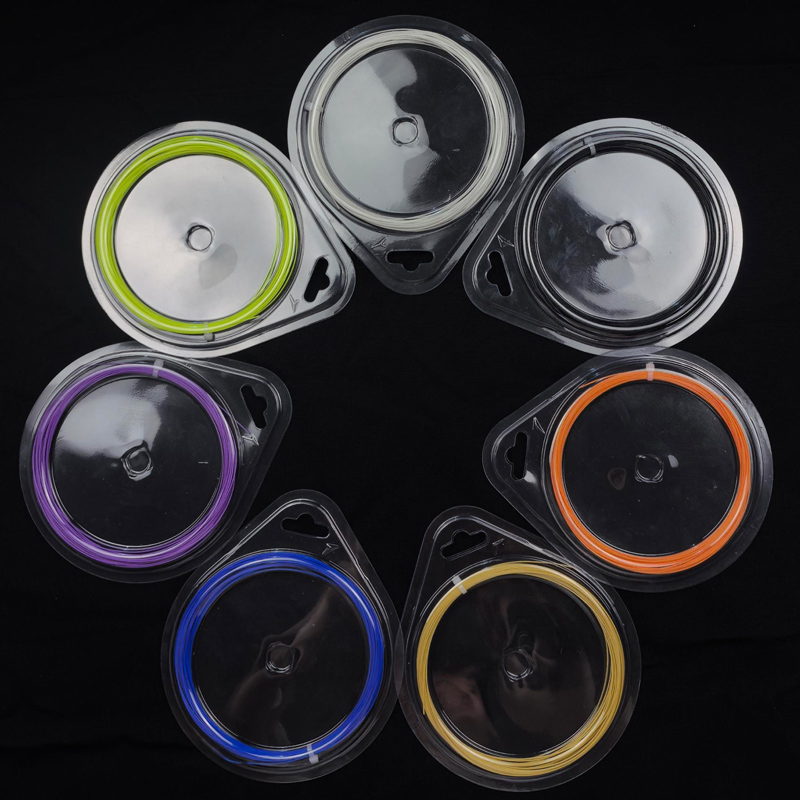
Second, how wide. Five gauges means five colour ranges, five pack designs, five barcodes. Our own colour options run from four to seven per model, and colour multiplied by gauge is the true SKU count. Consumables move through width, but width also parks cash in colours nobody reorders. A workable rule: full colour range on the main gauge, white and black only on the secondary ones.
Third, reel or single set. A 200 m reel serves customers with a stringing machine — clubs, pro shops, stringing studios. A single set serves the player who buys a string and takes it somewhere to be fitted. The two order patterns barely resemble each other: reels are stocked once and reordered quarterly; sets travel with racket sales and swing with them.
The pairing check most buyers skip
Strings have a tension ceiling and so do frames. Within our own full-carbon range the labels differ sharply: the ARES 80 is rated to 28 lbs, the NANO RAY 9900 to 24 lbs or below. Sell a 0.68 mm string rated to 30 lbs to a customer who wants it at 30 lbs in a frame rated to 24, and the string will survive while the frame does not. That warranty conversation is never a good one.
Treat frame and string as one unit when you build an assortment. A frame with a lower ceiling pairs with a 0.72 or 0.66 mm string rated to 24–26 lbs, forming a combination that cannot be assembled into a failure. A frame rated higher takes the 0.68–0.69 mm strings. Once you think in pairs, gauge stops being a consumable decision and becomes part of the product line architecture.
Overgrips belong to the same pairing logic; the mechanics behind that choice are covered in towel versus PU overgrips.
Frequently asked questions
Does a thinner string always break sooner?
At equal tension, yes — higher stress per unit of cross-section and a thinner wear layer. Strung at a genuinely lower tension, the gap narrows considerably.
Is 0.68 mm versus 0.69 mm worth two SKUs?
Not for the diameter. Possibly for the segment: the tension ceilings differ (26–30 vs 26–28) and so do the colour ranges. If both models serve the same buyer, keep one.
How many gauges should a small dealer stock?
Two: one mid-gauge that covers most walk-in demand, one thick gauge for training environments. Beyond three you need a stringing service to justify the width.
Where does the margin actually come from, reel or set?
Not from unit price — from turnover. Reels concentrate risk at the front and pay back slowly; sets turn fast with low exposure per unit. Carrying both is how the category stays stable.
Have us size the range for your customer base
If you are setting next season’s string structure — how many gauges, reel or set, how many colours — send us your target players and the frames you already carry, and we will map a stocking plan against the actual tension ratings. Talk to our team.