

Shuttlecock Grades: Feather Grade, Cork Build and Speed 76 vs 77
Shuttlecocks are one of the few categories where every unit looks identical and three separate specs decide everything. Put two grades side by side and nothing is visible; play two rallies and one starts shedding while the other starts drifting. A buyer who reduces this to “training ball or match ball” has collapsed three independent variables into one label.
Four models, three variables
| Model | Feather | Cork build | Speed | Position |
|---|---|---|---|---|
| FCS-01 | Grade C water duck | Two-piece cork | 76 / 77 | Training |
| FCS-02 | Grade B cigu duck | Two-piece cork | 76 / 77 | Training |
| FCS-09 | Grade A cigu duck | — | 77 | Tournament |
| FCS-07 | Goose | Three-layer cork | 76 / 77 | Tournament (advanced/club) |
The three variables are feather grade and species, cork construction, and speed. Each governs a different outcome, and discussing them together loses the thread.
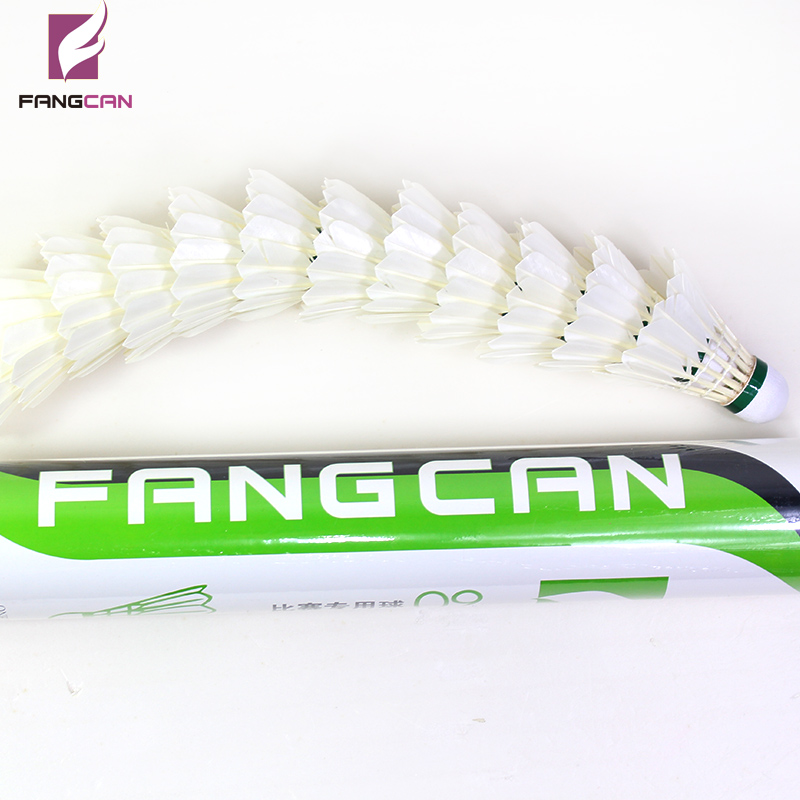
One: feather grade and species decide how long a ball lasts
Grades A, B and C sort the quality of a feather batch: uniformity of thickness, straightness of the quill, and how well left and right wing feathers are paired. Higher grades fly straighter and drift less on a deep clear.
Species matters more than grade for durability. Goose feathers have thicker, tougher quills and last longer under the same play; duck feathers (cigu duck, water duck) are softer and cheaper, which suits high-volume training. That means “Grade C goose” and “Grade A duck” cannot be compared directly — they sit on different axes.
So the purchasing rule is: training buys by cost per session, tournament buys by flight consistency. Training balls are costed against playing hours, where durability beats feel. Tournament balls are costed against how many are used per match, where an erring flight path ruins the game.
Two: the cork build decides how the ball feels — and when it dies
FCS-07 specifies a three-layer cork head: cork on the top and bottom layers, pressed cork granulate in the middle. FCS-01 and FCS-02 use a two-piece cork. The difference appears at contact, in deformation and rebound: a higher proportion of natural cork gives a crisper feel and more directional control, while more pressed granulate lowers cost but dulls the response.
The cork also sets the lifespan ceiling. The head is the first part to soften — the feathers can still be intact while the cork has collapsed, and at that point the ball is finished. Putting cork at both outer layers is precisely how a three-layer build delays that collapse.
A practical diagnostic: if complaints cluster around “the head goes soft too fast”, the problem is the cork build, not the feathers. Upgrading the feather grade will not fix it.
Three: speed 76 versus 77, the most misread number on the tube
Higher speed numbers mean a faster ball. The number does not describe a grade; it describes air density at the venue. Warm air is thinner, the ball travels further, so a lower number (slower ball) is used; cold air is denser and the ball stalls, so a higher number is used. Altitude works the same way.
The buying implication is direct: the same model sold into different markets needs different speeds. Our four models are specced at 76/77 (FCS-09 at 77 only). A market with a genuine cold season, or cities at altitude, may find 76/77 too slow in winter — the customer experiences “the ball won’t travel” and files it as a quality complaint.
The workable approach is to fix the target market’s climate band first, then confirm with the supplier which speed steps are available for that band, rather than treating 76/77 as universal. Speed deserves its own line on the purchase order.
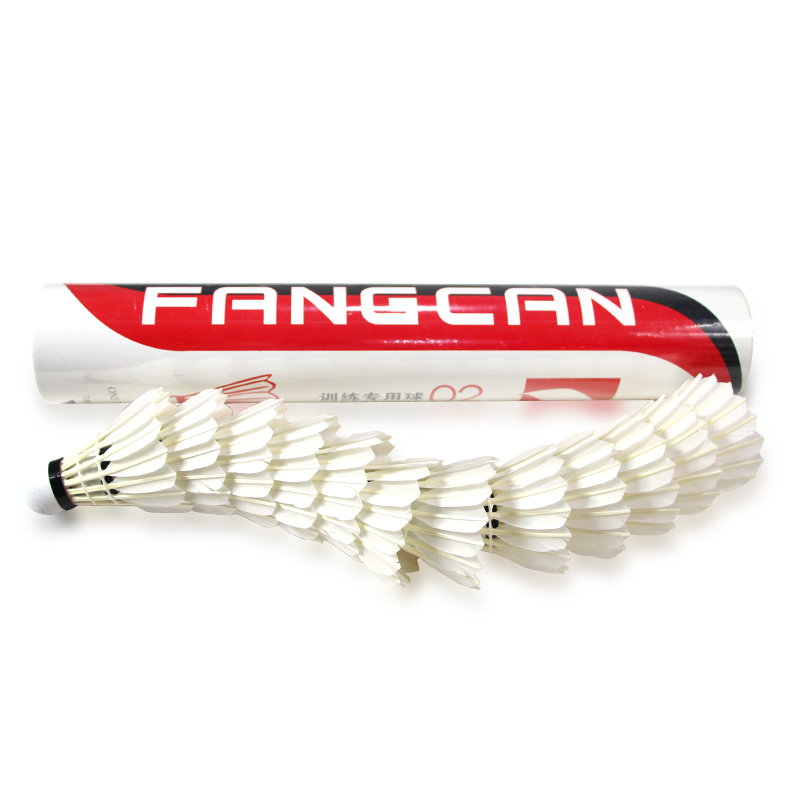
Planning the buy: grade by customer, not by price rank
Separate training from tournament first. Training channels — schools, club sessions, corporate events — consume volume and tolerate variance, so FCS-01 and FCS-02 carry the range. Competition and formal club play take FCS-09 and FCS-07.
Are FCS-01 and FCS-02 worth two SKUs? Yes, because the price step maps to a different customer: Grade C water duck is the lowest-cost option for high-frequency use, while Grade B cigu duck gives better feather quality on the same two-piece cork for training groups that care about durability. Keeping both creates an upgrade path.
Keep goose depth shallow. It carries the highest unit price of the four and attracts the least price comparison — buyers of goose feathers already know what they want. Quarterly, small batches beat a half-year commitment.
Work out the tube economics. All four pack 12 per tube. If retail needs split sales, the open-close behaviour of the tube affects the second sale, and that question belongs in packaging selection rather than in a complaint from the shop floor.
Frequently asked questions
Grade A duck or goose — which is better?
Not directly comparable. Grade A describes sorting quality within one species; goose and duck are different species. Compare two numbers instead: durability under the same play, and flight stability on a deep clear.
Is speed 77 the standard?
77 is the most common middle step, not a universal setting. Warm or high-altitude venues use lower numbers; cold venues use higher ones.
Is a two-piece cork worse than three-layer?
For feel and resistance to collapse, the three-layer build is better; the two-piece costs less, which is a reasonable trade for training. Choose by use, not by which sounds more advanced.
Is a drifting ball a quality problem?
Check speed and venue conditions first. A slow ball plus draught or low temperature will make a perfectly good shuttlecock drift. Rule out the environment before examining feather pairing.
Want a graded stocking plan for shuttlecocks?
If you are setting next season’s shuttle range — how much training against tournament, and which speed steps to hold — send us your market climate and customer mix and we will return a combination built on feather grade, cork and speed. Talk to our team.