

Racket Frame Materials: Read the Tension Ceiling, Not the Adjective
The material column on a racket spec sheet is the vaguest field and the one that moves the price most. “100% graphite”, “H.M. graphite”, “30T”, “ULTRA H.M.”, “carbon + aluminium” — they read like marketing, but each maps to a measurable quantity: the stiffness ceiling of the frame. And that ceiling ultimately decides how much tension the frame will take.
Line up our own models by material and the logic becomes plain.
Five ways of writing material, five stiffness bands
| Model | Frame | Shaft | Weight | Max tension |
|---|---|---|---|---|
| OUR HOME / FOREVER 999 | Steel | Carbon | 95±5 g | ≤20 lbs |
| STORM CC6.0 / STORM 90 | 70% graphite + 30% glass fibre | 100% H.M. graphite | 3U 85–88 g | 20–24 lbs |
| NANO RAY 9900 | 100% graphite | — | 3U 84±2 g | ≤24 lbs |
| N90II | 30T 100% H.M. graphite | — | 3U 87±2 g | ≤27 lbs |
| THRUSTER K15 | 100% carbon + nano | M40 100% H.M. graphite | 3U 85±3 g | 20–28 lbs |
| N90 III | 40T high-modulus graphite + woven carbon | Same construction | 3U 87±2 g | ≤35 lbs |
What stands out: weights are almost identical (3U, 84–88 g) while the tension ceiling runs from 20 to 35 lbs. Similar weight means the difference is not how much material is used, but how stiff that material is.
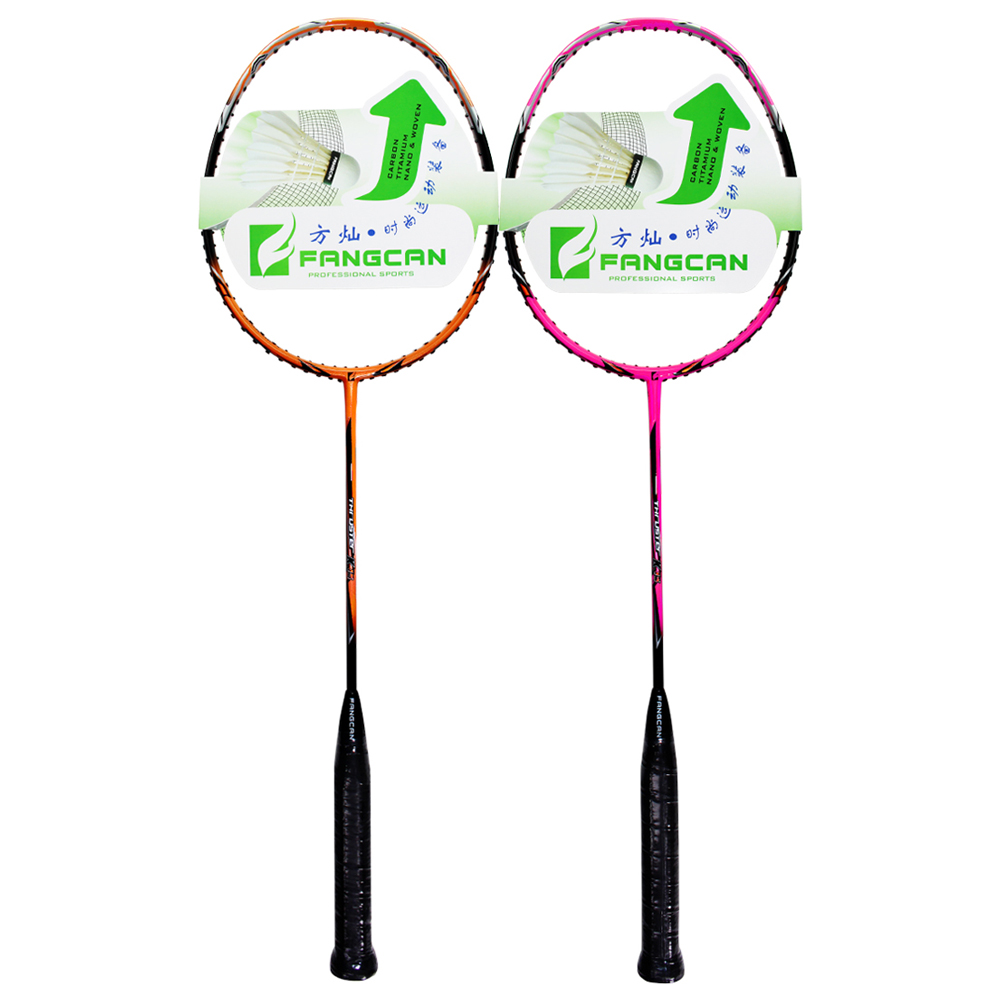
What “70/30” and “100%” actually differ on: stiffness, not weight
Graphite and glass fibre differ mainly in elastic modulus — under the same deformation, carbon fibre carries higher stress. Adding glass lowers overall stiffness while reducing cost and improving toughness.
So the STORM series’ “70% graphite + 30% glass” is not corner-cutting; it is a trade. Slightly lower frame stiffness, better impact resistance, more controllable cost. It lands at a 20–24 lb ceiling, which is exactly the amateur mid-to-high tension band.
N90 III takes the other route: 40T high-modulus graphite plus woven carbon, in a two-stage optical forming construction, pushing the ceiling to 35 lbs. The cost is price and process difficulty.
A useful buying heuristic: read the ceiling, not the material name. The ceiling is the result; the material wording is the process. A supplier can dress up the wording, but a stated ceiling is a constraint.
Steel frame with a carbon shaft: why only 20 lbs
OUR HOME and FOREVER 999 combine a steel frame with a carbon shaft, weigh 95±5 g, and are rated to 20 lbs or below.
That is a cost-driven structure: steel is cheap, easy to form and impact-tolerant, but heavy and low in stiffness. The carbon shaft restores some rebound. The result is a school, corporate-event and entry-retail frame.
At 95 g it is heavier than 3U (85–88 g) yet carries the lowest ceiling — another reminder that weight and stiffness are separate variables. Whether a frame tolerates high tension depends on its structure and material, not its mass.
Squash and pickleball follow the same logic
Among squash frames, the FCSQ-01 is carbon plus aluminium at 230 g and ≤26 lbs; the DARKNESS 7 is ULTRA H.M. graphite at 145 g and ≤35 lbs. Same pattern: higher material grade, lower weight, higher ceiling.
Pickleball paddles obey it too, just in a different form. The face sets the response, the core sets overall stiffness. Our JP25 uses an aluminium honeycomb core (2 × 0.05 mm), the JP26 a paper honeycomb, and the T700 model pairs a carbon face with a 16 mm core. A paddle has two material layers — face and core — and discussing only one distorts the comparison.
How to use this column when buying
One, translate material into ceiling. Ignore adjectives; check whether the stated ceiling and weight are self-consistent. A 3U frame rated 35 lbs on a 70/30 frame deserves a question.
Two, separate frame from shaft. Many models differ between the two (the STORM series is the clearest case). “100% graphite” without saying which part says nothing.
Three, watch the RA value. STORM CC6.0 lists a flexibility of 8.0–8.5 RA — a frame stiffness figure where higher is stiffer. It relates to both ceiling and feel, but it is not the same thing as either.
Four, put material into the RFQ. Require three separate columns: frame material, shaft material, tension ceiling. With all three filled, quotations become comparable.
Frequently asked questions
What do 30T and 40T mean?
They denote the tensile modulus grade of the carbon fibre — a higher number means higher modulus and greater stiffness. It does not mean the finished racket is better; lay-up design and forming process matter as much.
Is glass fibre a cheap material?
Not inherently. It lowers stiffness and raises toughness, which is a sensible choice for an impact-loaded frame. What matters is the ratio and whether it suits the use.
Can I string above the stated ceiling?
Not advisable. The ceiling is a structural boundary; going beyond it deforms or breaks the frame, and that is not covered as a defect.
Why do two 3U frames differ so much in ceiling?
Because weight can be tuned through wall thickness and balancing, while stiffness can only come from material and structure. They are independent engineering variables.
Want a material comparison sheet?
If you are comparing several suppliers’ frames of the same spec and want a sheet that aligns frame material, shaft, weight and tension ceiling, tell us the model range and we will return a template. Talk to our team.