

Vibration Dampeners: Weight, Slots and Pack Size
A vibration dampener does two things, and only one of them is physical. Physically it adds a few grams at the bottom of the string bed and shortens the ring of the frame after contact. Commercially it turns a stringing transaction into a small bundle, which is why this item earns its place in an accessory range despite costing almost nothing.
The specification is short but not empty. Weight, fit and pack count each change whether the product works, and each is routinely left off the purchase order.
Weight: the number that changes feel
Dampeners are sold anywhere from roughly two grams to six. At the light end the effect on feel is close to undetectable; at the heavy end the added mass at the throat is noticeable in the swing, and some players will reject it on the first hit. For a buyer, the useful framing is that this is a tuning part, not a cosmetic one — and a tuning part sold in one weight only serves one preference.
Two weights cover the realistic demand: a light unit for players who want the sound change without the swing change, and a heavier unit for players who want the frame to feel deader. A range of six weights is a catalogue decision, not a stocking decision.
Fit: how many strings it has to straddle
The dampener mounts between two adjacent main strings, and the gap between those strings varies with the pattern. On a dense 22×23 pattern the gap is tighter than on an open 20×22, and a moulded dampener that fits one will either rattle or refuse to seat on the other.
This is the specification that generates the most silent failures. A dampener that does not seat properly will fall off during play, and the customer will conclude the product is junk rather than that the fit is wrong. If your range spans both dense and open patterns, specify the compatible string spacing on the packaging. It costs a line of print and removes a whole category of complaint.
Pack count: why sixteen and not one
Sold as a single unit, a dampener is a coin-toss attachment at the counter. Sold as a multi-piece pack, it becomes something else: a shop can use it as a giveaway, a club can distribute it, and a household with three players can replace losses without a second trip.
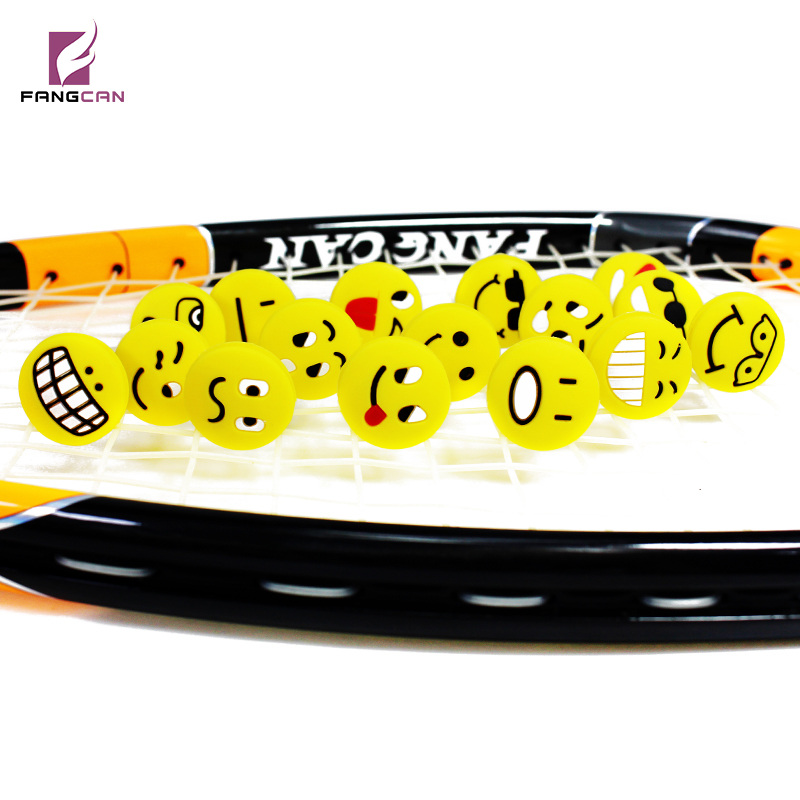
The economics are straightforward. The unit cost difference between a one-piece bag and a sixteen-piece bag is almost entirely packaging, so the larger pack carries a far better ratio of perceived value to landed cost. It also solves the loss problem that suppresses repurchase on small items — nobody returns to buy a second dampener, but plenty of people buy a pack once a season.
Design as a stocking decision
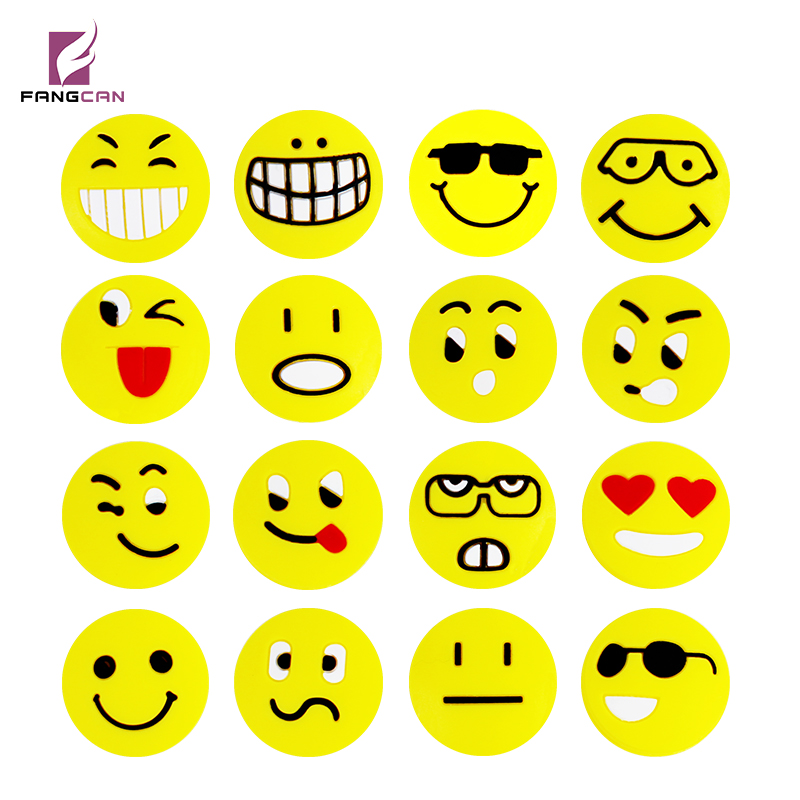
Shaped and printed dampeners — faces, flags, characters — sell faster at retail than plain discs and cost only slightly more to produce. The trade-off is inventory: each design is a separate SKU, and a range of twelve designs will be out of stock in the popular three most of the time.
The practical compromise is a mixed pack. One bag carries several designs, the retailer gets variety without SKU proliferation, and the buyer’s own purchase order stays at one line. If you are commissioning a custom design, treat the artwork cost as tooling rather than as a per-unit charge — it is amortised over the whole run, and it is the part that makes the product defensible against a plain-disc competitor.
What to put on the purchase order
- Weight in grams, with a tolerance band rather than a nominal figure.
- Compatible string spacing, stated as a range.
- Material and hardness, since soft silicone grips but deforms.
- Design count per pack, and which designs are fixed versus rotating.
- Retail packaging with the fit range printed on it.
- Carton quantity, because freight on a light bulky bag is mostly volume.
For a first order, the mixed pack is the lower-risk entry: it tests demand across designs without committing to a mould for each. Pair it with the single head protection strip as the two cheapest attachment items in the range, and treat both as fixed lines in the quotation structure rather than as optional extras — the items that get quoted as options are the ones that get dropped.
Where it belongs in the store
Position decides whether this item sells at all. Next to the stringing counter it is an add-on that costs the customer almost nothing and takes the staff two seconds to mention. In a general accessory bin it is invisible.
There is also a service argument. A dampener is the cheapest way to change how a racket feels without changing anything structural, which makes it a low-risk suggestion for a customer who is not ready to restring. That is a conversation a good counter has, and the product only needs to be within reach for it to happen.
Two weights, one product line
The reason to carry two weights rather than one is not that customers ask for it. It is that a single weight forces every buyer into the same compromise, and the customer who wanted something else simply does not come back. In a category where the unit price is a few cents, losing the second sale costs more than the second SKU.
The same logic argues against carrying five. Each additional weight is another bag to count, another line to explain at the counter, and another item that will be out of stock in the size that actually moves.