

Shuttlecock Humidity: Why the Same Tube Plays Faster
Feather shuttlecocks are the only common piece of sports equipment whose performance changes measurably with the weather in the warehouse. The feather is a natural material that takes up and releases moisture, and both brittleness and flight follow from how much water it is holding. This is not folklore: it is why the same tube plays differently in a dry hall and a humid one, and why a shipment that sat in a hot container for six weeks arrives playing faster than the sample did.
Two failure modes, opposite directions
Dry feather becomes brittle. The quill cracks at the point where it enters the cork, usually within the first few hits, and the tube is finished. Humid feather becomes soft: the skirt deforms under load, the shuttle slows and starts to wobble, and the flight path stops being predictable.
Both are the same physical variable moving in opposite directions, which is why “my shuttles break too fast” and “my shuttles fly too slow” can be the same complaint from two different climates.
What the speed number actually means
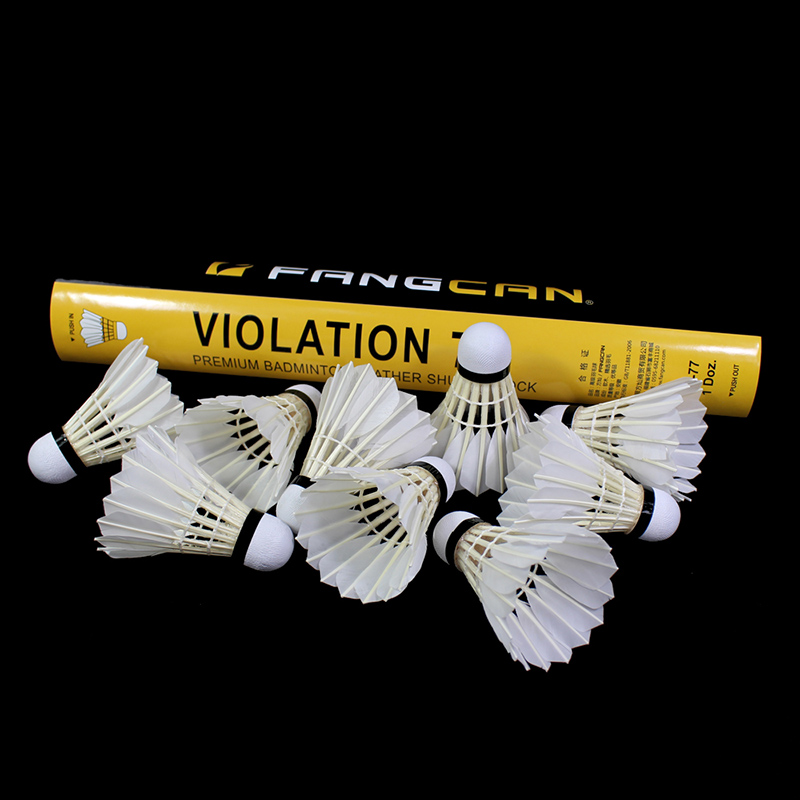
Speed grades — 75, 76, 77, 78 — are not arbitrary. The number corresponds to the weight of the shuttle in grains, which is why a higher number is a heavier, faster shuttle. Standard tournament shuttle weight sits in the 4.7–5.5 g range, and the grade is chosen for the conditions of the hall rather than for the player’s preference.
The acceptance test is published and worth using: struck with a full underhand stroke from one back boundary line, a shuttle should land not less than 530 mm and not more than 990 mm short of the opposite back boundary. That single test tells you whether a batch is in the grade you ordered, and it takes one player and two minutes. Put it in the incoming inspection, not just in the supplier’s own report.
Storage: the part of QC that happens after arrival
Industry practice keeps tubes at roughly 45–60% relative humidity, away from direct heat and away from air-conditioning outlets. Below that band, feathers dry out and the first-hit breakage rate climbs. Above it, the cork and the glue line take up moisture and the shuttle gains weight.
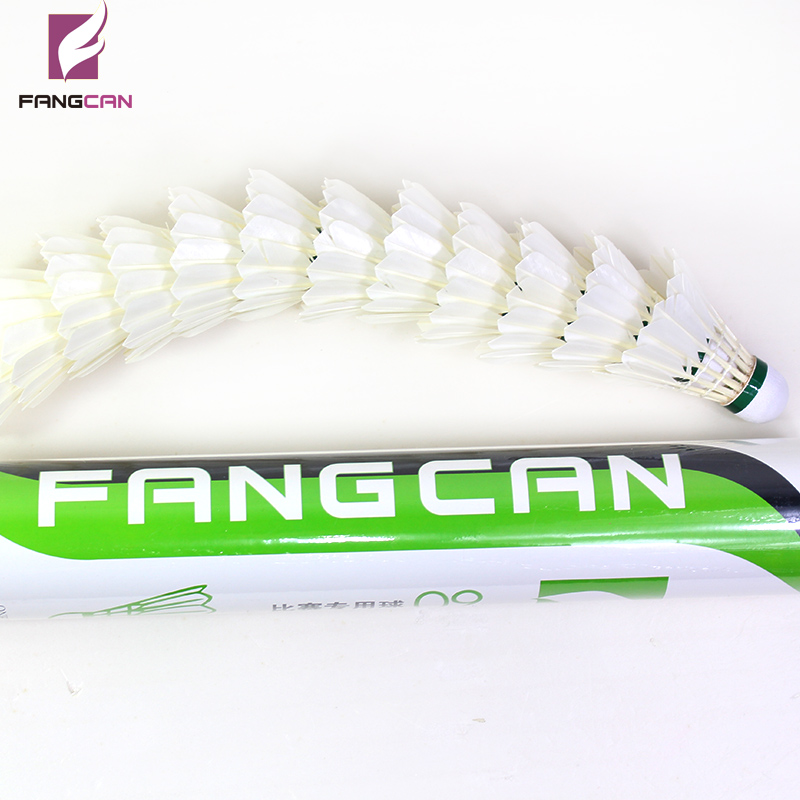
For a distributor this has three practical consequences. Store cartons off concrete floors, since a cold floor drives condensation. Keep tubes in their cartons rather than loose on a shelf, because the carton is a moisture buffer. And if the destination climate is much drier than the source, plan a settling period before the goods are sold — a tube that has just come off a dry flight will play differently after a week in the shop.
Humidifying, honestly
The common trick of leaving tubes over a bowl of water overnight works, and it is also the fastest way to overdo it. A few hours is enough; a whole night in a humid room can push a 77 into behaving like a 78. For a club, the controlled version is a sealed box with a humidity gauge, not a wet towel in a bag.
None of this belongs in a sales claim. It belongs in the instructions, because the customer who knows why a tube broke is a customer who buys again; the one who does not concludes the product is bad.
What to specify
- Speed grade, and the acceptance test that confirms it.
- Feather type and grade: goose, duck, or selected duck, stated precisely.
- Cork construction: natural, composite, or foam — this decides feel and price.
- Moisture content or the storage humidity the factory recommends.
- Tube sealing, since a sealed tube holds its moisture far better in transit.
- Carton quantity and stacking limit, because crushed tubes are unsellable.
For a range, the sensible split is one training grade and one tournament grade per feather type you carry: for example the selected duck training shuttle for club practice and the goose tournament shuttle for match play, with the water duck grade as the entry price point. Three grades, three prices, one test method — and the test is what keeps the customer believing the grades mean something.
Container conditions: the leg nobody measures
A sea container crossing the tropics reaches temperatures well above ambient, and the humidity inside moves with it. A carton of shuttlecocks that spends six weeks in that environment arrives with a different moisture content from the sample that was approved, and the difference shows up as first-hit breakage in the customer’s hall.
The mitigation is not complicated: sealed tubes rather than open ones, cartons off the container floor, and a settling period at destination before the goods are sold or graded. None of it adds cost; all of it requires someone to write it into the shipping instructions.
Container legs and the moisture nobody measures
Most moisture problems in this category are created after the factory gate. A carton that sits on a container floor picks up condensation on the crossing, and a tube that was sealed correctly in a dry plant can arrive with damp cork.
The cheap countermeasures are structural: sealed tubes, cartons on dunnage rather than the floor, and a desiccant sachet per carton on long routes. None of them change the product; all of them change what the customer receives.