

Forming Process: One-Piece, Two-Stage, Sectioned or Sandwich
Two rackets can both say “full carbon” and feel entirely different. The difference often sits not in the material but in the forming process — how the material is turned into a racket. That step determines the path forces take and where a frame is most likely to fail.
Our range shows four distinct structures, each with its own trade.
Four structures, four force paths
| Structure | Example | Force path | Trade-off |
|---|---|---|---|
| One-piece forming | TURBO CHARGING 77 | No interface between frame and shaft | Consistent feel; higher tooling and process demand |
| Two-stage forming | N90 III (40T two-stage optical) | Frame and shaft formed separately, then joined | Independent stiffness per section; the joint is a stress point |
| Sectioned materials | STORM CC6.0 (frame 70/30, shaft 100% H.M.) | Each section specified for its own job | Fine balance of cost and performance |
| Steel frame + carbon shaft | OUR HOME / FOREVER 999 | Hard frame, soft shaft, rebound concentrated in the shaft | Lowest cost; ceiling only 20 lbs |
All four come down to one question: where the interfaces are. Fewer interfaces mean a more continuous force path; more interfaces allow each section to be tuned separately, at the cost of stress concentration at the joints.
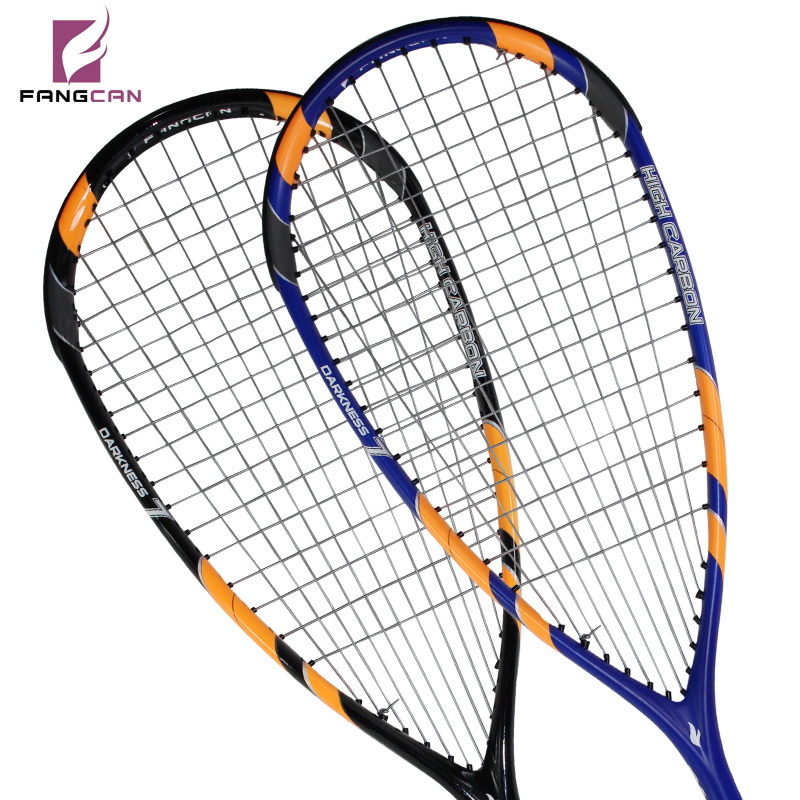
One-piece: one interface fewer, one uncertainty fewer
TURBO CHARGING 77 is specified as “full carbon, one-piece optic forming”, 3U 84±2 g, rated to 24 lbs.
The point of one-piece forming is that there is no physical interface between frame and shaft. A split structure inevitably has a material transition and an adhesive layer at the joint, and those are exactly where fatigue appears first under sustained load. One-piece forming removes that variable.
The cost is equally clear: larger tooling and tighter process control, hence a higher reject rate. Which is why it appears in mid-to-high models rather than across the range.
One confusion worth clearing: “one-piece forming” and “full carbon” are different claims. The first describes process, the second material. A racket can be full carbon and two-stage, or one-piece and glass-blended.
Two-stage: different stiffness for different sections
N90 III is “40T two-stage optical forming”, 3U 87±2 g, specified as on the stiff side, rated to 35 lbs.
The logic is the opposite of one-piece: forming frame and shaft separately lets each be given its own stiffness. The frame must resist torsion and hold high tension; the shaft must transmit and return energy. Different jobs, easier to satisfy separately.
It is also why a 35 lb ceiling appears on a two-stage frame — the frame can be reinforced independently, without being limited by the shaft’s forming conditions.
The cost is joint reliability. Process quality at that one point decides whether the frame survives at its rated ceiling. When comparing high-tension frames, ask about the joining process, not just the number.
Sectioned materials: the most practical middle route
STORM CC6.0 is the clearest case: frame 70% graphite + 30% glass, shaft 100% H.M. graphite, frame spec 11 mm, 76 string holes, nylon 12 eyelets, shaft 7.0 × 3.2 mm, flexibility 8.0–8.5 RA, grip G3#.
The thinking is visible in that set: put the good material in the shaft, hold cost in the frame. The shaft is where feel and power transmission come from, so it gets 100% H.M. graphite; the frame blends glass to cut cost and raise impact tolerance; 11 mm is a narrow frame section aimed at lower drag.
For a buyer this structure is the easiest to sell and to explain — it does not need a narrative, because the parameters already describe the trade.
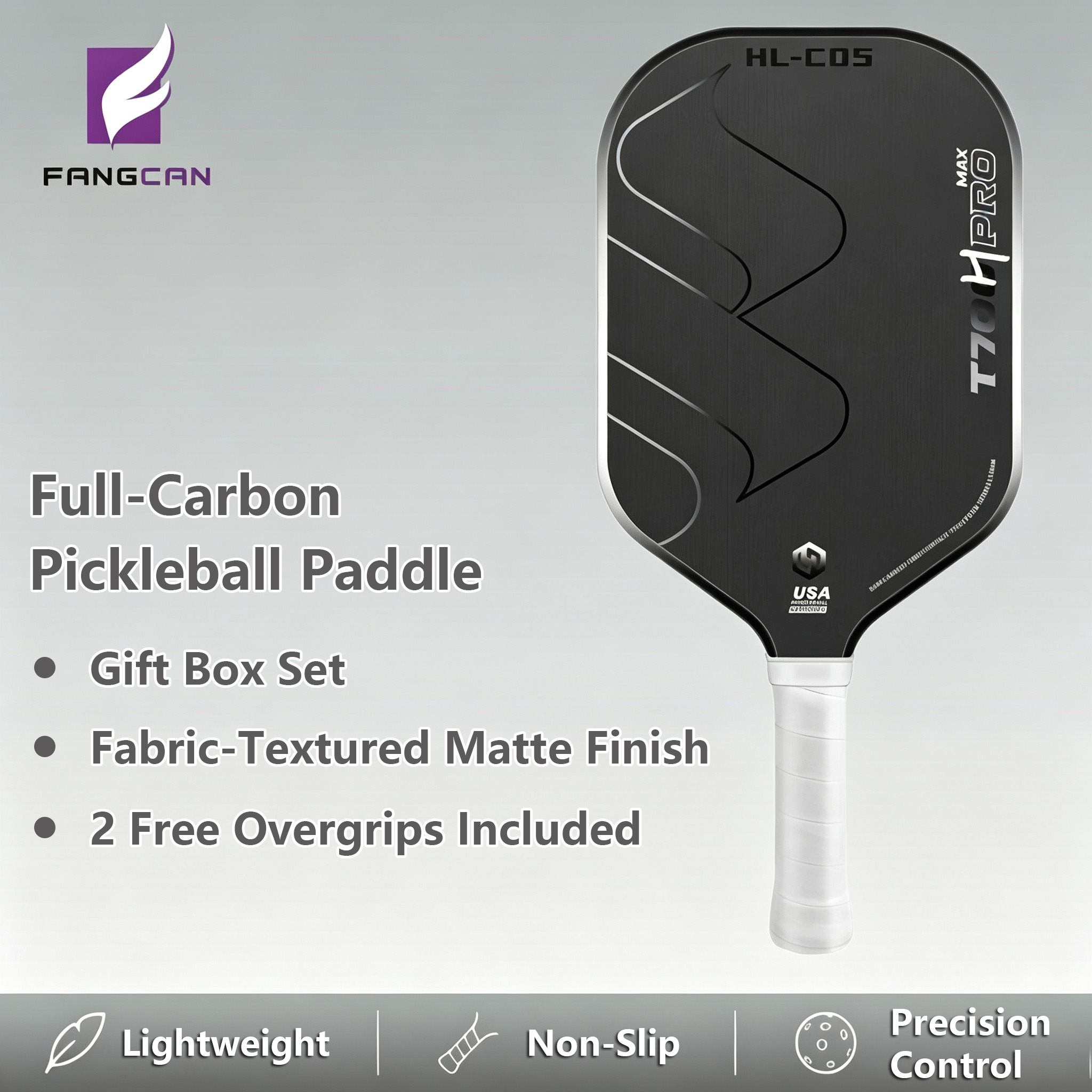
Pickleball is a different structural logic: a sandwich
A racket is formed as a body; a paddle is a sandwich — two thin faces around a honeycomb core. Ours: JP25 with an aluminium honeycomb core (2 × 0.05 mm), JP26 with a paper honeycomb, and the T700 model with a carbon face and a 16 mm core.
The mechanics are “separate the faces, raise the second moment of area”: material placed further from the neutral axis resists bending far better at the same weight. That is why faces can be very thin while the paddle still feels stiff.
Core choice is about cost and durability: aluminium honeycomb is stronger and more compression-resistant at higher cost; paper honeycomb is lighter and cheaper but more moisture-sensitive. That difference is invisible in dry markets and magnified in humid ones — choose the core for the environment the product will live in, not just the price.
How to use this column when buying
One, ask for the forming process. Material without process is half the information. Require one of: one-piece, two-stage, sectioned, sandwich.
Two, check process against the ceiling. A high ceiling needs a frame structure that supports it. If the process cannot, the number is not credible.
Three, separate process claims from material claims. One-piece does not mean full carbon, and full carbon does not mean one-piece.
Four, for sandwich products ask about the core. In paddles the core governs stiffness, weight and weather resistance — a more useful comparison than face material alone.
Frequently asked questions
Is one-piece always better than two-stage?
No. One-piece wins on continuity and consistency; two-stage wins on independent stiffness. Which is better depends on the target tension and feel.
Is the joint a weak point?
It is a stress concentration point, and process quality decides reliability. That is why high-tension frames should be questioned on joining, not only on the number printed.
Is aluminium honeycomb better than paper?
Stronger and more compression-resistant, at a higher cost. In a dry market with moderate use, paper offers better value.
Why do some models omit the process?
Either it is standard and needs no emphasis, or it is not a strength. Ask directly; if there is no answer, assume the lower tier.
Want a structure and process comparison sheet?
If you are comparing structures across models — one-piece, two-stage or sectioned — tell us the models and target tension range and we will return a comparison sheet. Talk to our team.