

Thirteen Overgrip Models: Tacky vs Dry, Flat vs Keel, and the SKU Trap
Overgrips are the widest category we carry: six flat models and seven keel models, with a spec table dense enough to look like noise. In practice only three dimensions matter — tacky or dry, flat or ridged, and 0.65 mm against 1.9 mm. Read those three columns and thirteen models become a table you can actually buy from.
First, split flat from keel
| Model | Surface | Process | Thickness | Colours |
|---|---|---|---|---|
| FCOG-02 film | Tacky | Surface film | 0.8 mm | 8 |
| FCOG-03 buffed | Dry | Buffed grain | 0.8 mm | 8 |
| FCOG-06 stiletto | Dry | Dot emboss | 0.8 mm | 5 |
| FCOG-09 perforated film | Tacky | Film + perforation | 0.8 mm | 7 |
| FCOG-13 gradient | Tacky | Gradient dye | 0.65 mm | 8 |
| FCLG-01 senior keel | Tacky | Ridge + perf + EVA | 0.8 mm | 11 |
| FCLG-02 ridged perf | Tacky | Ridge + perf + EVA | 0.8 mm | 10 |
| FCLG-03 stitched keel | Dry | Ridge + stitching + perf | 1.9 mm | 5 |
| FCLG-04 buffed keel | Dry | Ridge + buffed + perf | 0.8 mm | 6 |
| FCLG-06 thick wide | Tacky | Ridge + film + thick | 0.8 mm | 6 |
| FCLG-07 dual EVA | Tacky | Ridge + dual colour | 0.8 mm | 10 |
| FCLG-08 dual colour | Tacky | Ridge + dual film | 0.8 mm | 11 |
Twelve of the thirteen are 0.8 mm. The only exceptions are FCLG-03 at 1.9 mm and FCOG-13 at 0.65 mm — which tells you thickness is not the main selection axis. Surface and texture are.
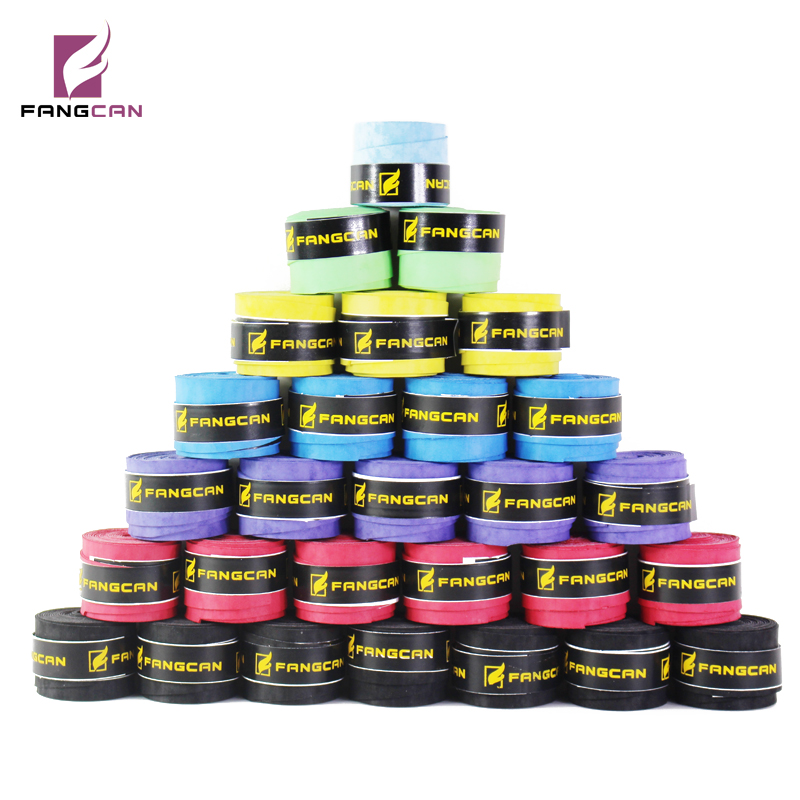
Tacky and dry: choose by climate and sweat, not by price
Tacky grips hold through surface adhesion, which suits dry climates and players whose hands stay dry. Dry grips hold through texture — buffed grain, embossed dots — so they still grip once the hand is wet, which suits hot and humid markets.
This is the most useful purchasing rule in the category: in the humid heat of Southeast Asia, dry grips out-repeat tacky ones. Copy a temperate-market assortment into a tropical one and you end up short on dry models with tacky stock sitting.
So allocate by region: humid markets lead with dry models (FCOG-03, FCOG-06, FCLG-03, FCLG-04); temperate and air-conditioned venues lead with tacky (FCOG-02, FCOG-09, FCOG-13 and the tacky keel models).
Keel is not a premium tier — it is a different friction mechanism
A keel grip carries raised ridges, so the wrapped handle becomes spiral. The purpose is not extra tack or extra thickness; it is a physical structure the fingers can lock against. For players who shift their grip or lose it once the hand is wet, a ridge is more reliable than a surface coating.
The cost is equally clear: ridges change the roundness of the handle, so the effective diameter grows a step, and pressure concentrates along the ridge — some players find it uncomfortable over a long session. Keel is therefore a different orientation, not an upgrade: aimed at the unstable grip rather than the player chasing fine feel.
What deserves more attention is the colour count. The seven keel models run 5, 6, 6, 10, 10, 11, 11 colours; the six flat models 5, 7, 8, 8. Stock everything and overgrips alone exceed a hundred SKUs — a disaster in a low-ticket category. Keep the main line in full colour, secondary lines in black and white only, and produce the rest to order.
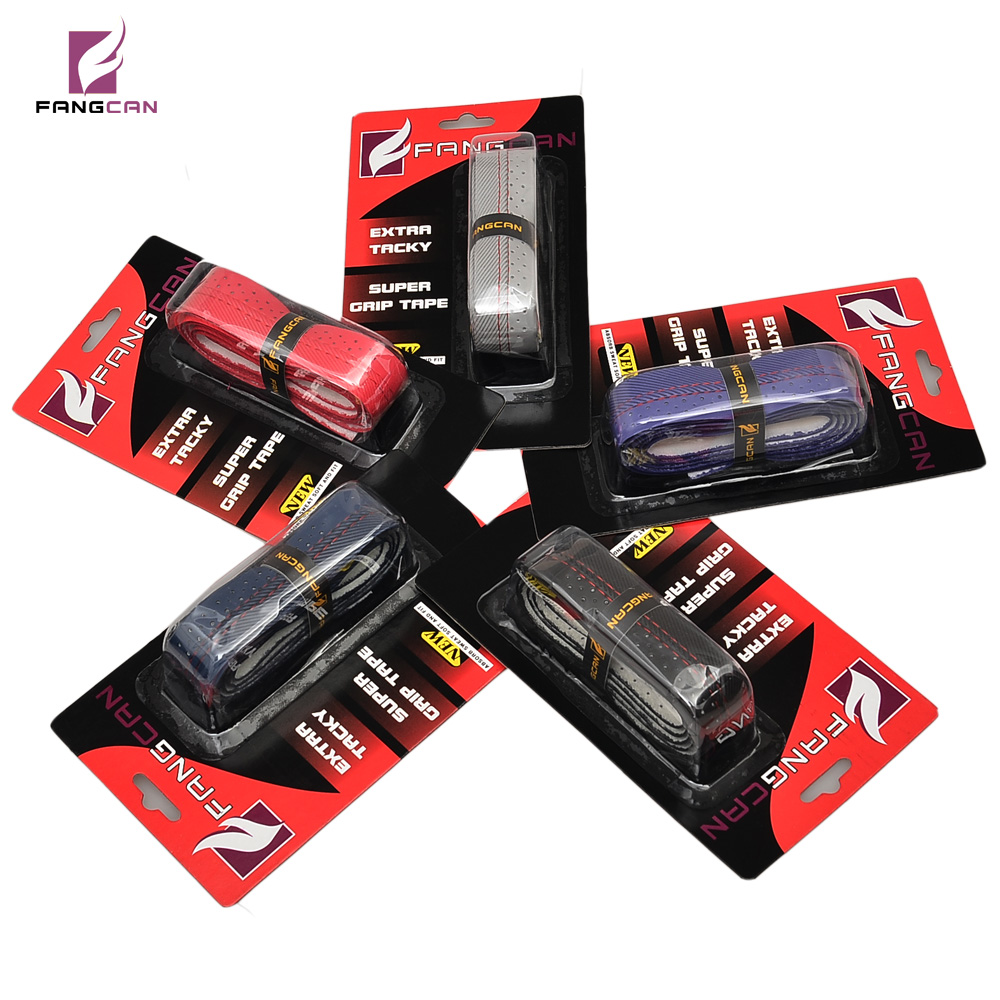
Two parameters buyers overlook: width and length
Flat models and most keel models are 25 mm wide; FCLG-06/07/08 are 26 mm. One millimetre is perceptible when wrapping — wider wraps faster with less overlap, narrower conforms better to a slim handle. It is not a selling point at retail, but it changes how many strips each racket needs at volume.
Length differences matter more. Most models are 1100 mm, FCOG-09 is 1140 mm, FCLG-01 is 1130 mm, FCLG-03 is 1090 mm. Length decides whether one strip covers the whole handle: a short strip on a long handle forces a splice, and a splice is where a wrap comes loose first.
One outlier: FCOG-10, 1500 × 35 × 1.5 mm with adhesive backing, specified for fishing rods, tennis, badminton and squash. It is not designed for racket handles but for long-distance wrapping — a cross-category SKU with an entirely different purchasing logic.
The finishing tape is not optional
A wrapped grip needs a finishing tape to close it. Our FCOG-04 is a PVC tape-sealing compound in 10 m and 20 m lengths, 1 cm wide, in black and white for 20 m and black, white, blue, red for 10 m.
Plenty of buyers stock grips without it, and the customer gets home to find the wrap will not stay. The tape costs almost nothing but decides whether the product works at all — pair it against grip volume as a standing ratio rather than waiting to be asked.
How to plan the buy
One, set the tacky/dry ratio by climate. This drives repeat purchase more than any pattern choice.
Two, flat carries volume, keel carries differentiation. Flat is the base of the range and the widest audience; keel earns the premium and does not need all seven models.
Three, cut colours to core. Four or five on the main line, two on secondary. Colour in grips is emotional purchasing, but clearing slow colours eats the premium it created.
Four, bundle the finishing tape. Getting the small accessory right visibly reduces complaints.
Frequently asked questions
Does grip thickness change the handle size?
Yes. Thickness multiplied by wrap count changes circumference; the arithmetic is in grip thickness versus grip size.
Is keel right for everyone?
No. It suits unstable grips and sweaty hands; players chasing fine feel may find the ridge intrusive. Match it to a customer, not to a default.
Can tacky and dry be sold together?
Yes, and they should be. Sweat levels vary widely within one market, and carrying both covers the full base.
Can ordinary tape replace finishing tape?
Briefly. PVC finishing tape stretches with the handle as it tightens; ordinary tape slips.
Want a simplified SKU plan for overgrips?
If the model and colour count has become unmanageable — and you want to narrow without guessing — send us your current sales mix and we will return a keep-list built on surface, texture and climate fit. Talk to our team.