

Beam Width, Head Size, Core Thickness: The Geometry That Sets Feel
Material decides how stiff a frame can be. Geometry decides how the force gets there. The columns buyers skip most often are the dimensional ones — beam width in millimetres, head size in square inches, core thickness in millimetres. They look minor and map directly onto three playing properties: drag, torsional stiffness and sweet-spot size.
This is also the least consistently reported group of specs, which makes price comparison unreliable if you ignore it.
Geometry we can actually verify
| Model | Dimensional spec | Bias |
|---|---|---|
| STORM CC6.0 | Frame section 11 mm, 76 string holes, shaft 7.0 × 3.2 mm | Narrow, speed |
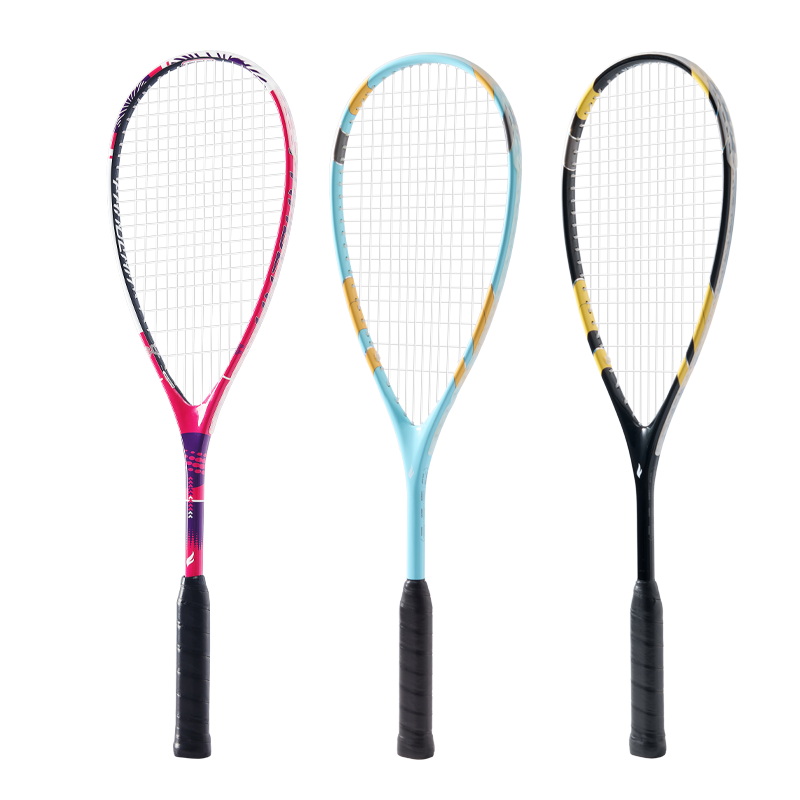
| FCSQ-01 | Beam width 20 mm, head 76 sq.in | Wide, stability |
| DARKNESS 7 | Beam width 20 mm, head 78 sq.in | Wide plus large head, torsion-led |
| SUPER A6 / A8 | Head 102 sq.in, pattern 19×16 | Large head, forgiveness |
| T700 paddle | Core 16 mm (0.63 in), length 420 mm | Mid-thickness, power-control compromise |
Note the gaps: most badminton frames do not state beam width, most paddles do not state head size, and squash frames state beam width but not shaft dimensions. This is not one supplier’s failing — it is the whole category’s reporting habit.
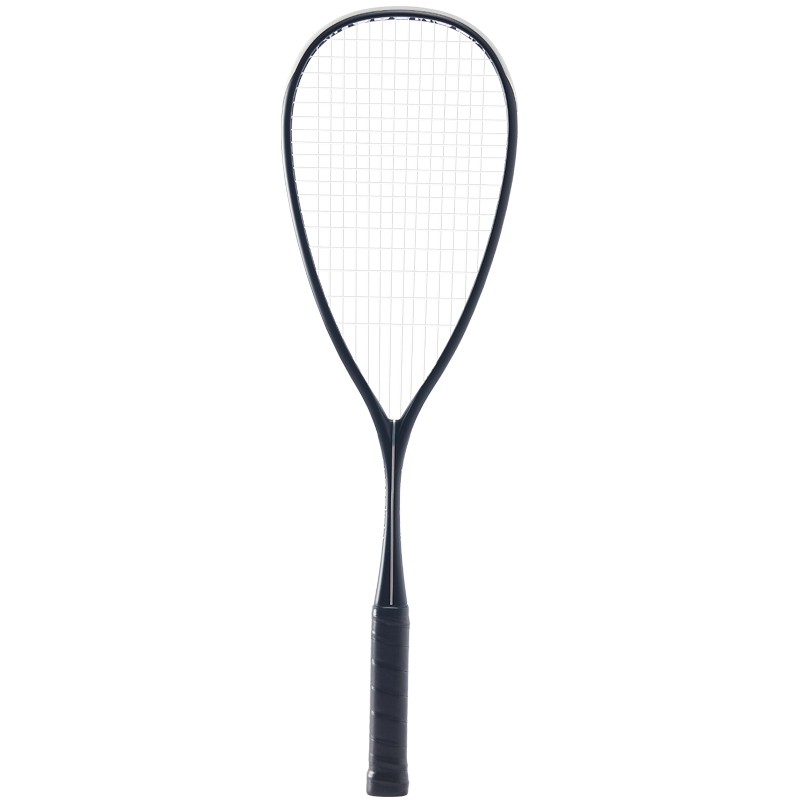
Beam width: torsion against drag
Beam width is the thickness of the frame section perpendicular to the string bed. Its engineering meaning is direct: a wider section resists torsion better; a narrower one meets less air.
What does torsional stiffness decide? Whether the frame twists when contact happens off the sweet spot. Less twist means a more stable exit direction — which matters most in sports where off-centre contact is normal, squash and tennis especially. The 20 mm beam of the DARKNESS 7 and FCSQ-01, paired with 78 and 76 sq.in heads, is a stability-first package.
What does drag decide? Swing speed. STORM CC6.0’s 11 mm section is clearly narrow, aimed at a faster swing — an advantage in fast doubles and counter-attacking play. The cost is lower torsional stiffness, which is why its ceiling sits at 20–24 lbs.
A coherent chain emerges: narrow frame → lower drag → faster swing → but limited torsion and load capacity → lower tension ceiling. Geometry, structure and ceiling are three faces of one argument.
Head size: sweet spot against uniformity
A larger head gives a larger sweet spot and more forgiveness; but at the same tension, a bigger string bed makes uniform tension distribution harder, and the outer areas rebound softer.
Which is why entry and casual players favour large heads: when contact is inconsistent, a big head reduces the cost of a mishit. The 102 sq.in of the SUPER A6 and A8, with a 19×16 pattern at 50–55 lbs, is a forgiveness-first combination.
Advanced players tend to go smaller: less sweet spot, more concentrated feedback, more precise control. The 74 / 76 / 78 sq.in options in our squash range are essentially three points on that curve.
Core thickness: the paddle’s governing dimension
A paddle’s 16 mm core plays the role of beam width in a racket: it sets how stiffness is distributed and how efficiently energy is transferred.
A thicker core has more room to deform, storing and releasing more energy — a power bias. A thinner core deforms less, giving more direct feedback — a control bias. The logic is the same as beam width: geometry sets deformation room, deformation room sets the feel bias.
So the correct order for comparing paddles is: core thickness and length first, face material second, weight last. Face material is the easiest to build a story around, but it comes after geometry.
What to do when the numbers are missing
Incomplete geometry distorts price comparison. Three remedies:
Ask for the missing figures. Beam width, head size and core thickness usually exist in the factory’s data; they are simply not published. Put them as separate lines in the RFQ.
Infer from proxies. Without beam width, combine the ceiling and head size to infer the bias: narrow frames usually carry lower ceilings, large heads usually signal forgiveness-first design.
Measure. Calipers for beam width and core thickness, a soft tape across the inner head for dimensions. Three minutes of work makes the sheet comparable.
How to use this when buying
One, add the three lines to the RFQ. Beam width, head size, core thickness — one line each.
Two, use geometry to test the ceiling. A very high ceiling on a very narrow frame deserves a question about structure and process rather than acceptance.
Three, match geometry to customer. Entry with a large head, advanced with a moderate one, fast play with a narrow frame. That mapping is more reliable than tiering by price.
Four, measure geometry at inspection. Not only weight — beam width and head size are the two measurements most likely to expose a tooling change or a shortcut.
Frequently asked questions
Is a wider beam always better?
No. A wide beam resists torsion but adds drag; a narrow one swings faster with less load capacity. Match the playing style, not a “wider is better” rule.
Is a bigger head easier to play?
For beginners, yes — more forgiveness. But a larger sweet spot is not the same as better feel, and advanced players usually prefer more concentrated feedback.
Is a 16 mm core a standard value?
It is a common mid-thickness: a compromise between power and control. Thicker leans power, thinner leans control.
Why is beam width often missing from listings?
Mostly a reporting habit rather than absent data. Ask directly at quotation stage and it usually appears.
Want a geometry comparison sheet?
If you are comparing beam width, head size and core thickness across models, tell us the range and we will return a template you can fill in directly. Talk to our team.