

Maximum Tension Is a Ceiling, and Tension Loss Comes in Two Stages
The “maximum tension” column on a string is the most misused field on the sheet. Some buyers read it as a recommendation and string straight to the ceiling. Others read it as a grade and assume the bigger number is the better string. Both are wrong, and in opposite directions.
It means one thing: the peak tension the frame or the string will take before permanent deformation. A limit, not a recommendation, and certainly not a durability figure.
Ceiling, recommendation, working value: three different numbers
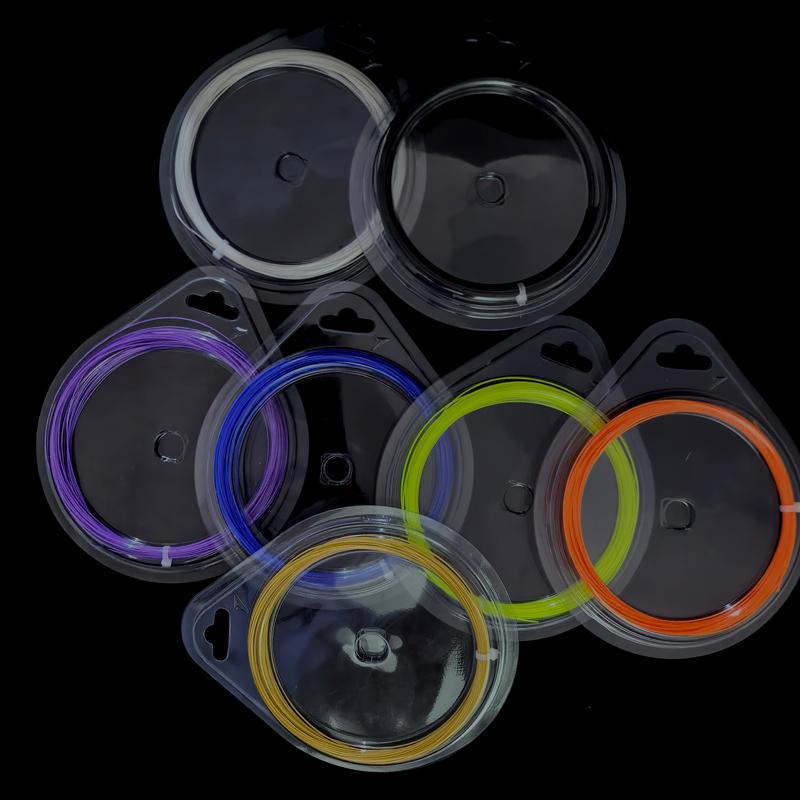
Take our five badminton strings.
| Model | Gauge | Material | Max tension |
|---|---|---|---|
| BG66 | 0.66 mm | Nylon | 22–24 lbs |
| BG85 | 0.69 mm | — | 26–28 lbs |
| BG95 | 0.68 mm | — | 26–30 lbs |
| BG2006 | 0.72 mm | Nylon | 22–26 lbs |
| BG2009 | 0.69 mm | Nylon | 26–30 lbs |
One thing here runs against intuition: the thinnest string, BG66 at 0.66 mm, has the lowest ceiling at 22–24 lbs — and the thicker BG2006 at 0.72 mm is only 22–26. If gauge alone set the ceiling, 0.72 mm would sit higher. It does not.
So the ceiling is not a function of gauge. It is a function of material and construction. BG95 is 0.68 mm and rated to 30 lbs — same brand, same category, different material system. Which is why guessing the ceiling from the diameter does not work.
Tension loss happens in two stages, and only one is controllable
From the moment a frame is strung, tension starts to fall. The process has two parts with completely different natures.
Stage one is stress relaxation. The string creeps under sustained load while knots tighten and the string settles into the holes. It concentrates in the first hours after stringing, then the curve flattens. Crucially, pre-stretch reduces this stage substantially.
Stage two is fatigue accumulation. Every shot stretches the string and only partly returns; the remainder becomes permanent set and accumulates. This cannot be avoided, only resolved by restringing. It correlates with hitting frequency rather than elapsed time — a racket left in a bag barely develops stage two at all.
The distinction has commercial value. When a customer complains that the string went soft within a week, ask how much they played. If it happened under heavy use, that is stage two and normal wear. If it happened with almost no play, stage one was handled badly or the string’s creep behaviour is poor.
Material sets the shape of the curve, not its quality
Different materials produce differently shaped curves. That shape, not a headline number, is what selection should follow.
Harsh polyester. Our TS102 is a 1.35 mm harsh polyester tennis string. Polyester loses a concentrated chunk early and then flattens — once settled, it holds for a long time. The cost is a stiff feel and little elasticity.
Nylon and semi-gut. TM101 is a 1.20 mm cross-colour squash string in polyester multifilament; the TM102 in the same family is nylon semi-gut. Nylon curves are gentler but keep descending, while retaining far more elasticity.
Neither is better. Match the curve: players who need stable tension — competitive, frequent restringing — go polyester; players who need feel and elasticity — beginners, casual — go nylon. Criticising nylon for tension loss, or polyester for stiffness, mistakes curve shape for quality.
Measure it yourself; it beats any claim
There is no universal tension-loss figure, because machine, technique and batch all move it. Measuring your own is cheap.
Four checkpoints. Immediately after stringing, at 24 hours, at 7 days, and after five hours of play.
One fixed point. Measure with a tension gauge at the same spot just above the sweet spot. Do not tap and listen — pitch shifts with room acoustics and frame resonance, and the same person gets different readings on different days.
Four columns. Model, initial value, 24-hour value, 7-day value. Three batches of the same model and you own your own curve.
The value here is not precision, it is comparability: once two strings are measured the same way, which one drops faster stops being an argument.
How to use this column properly
Three things a buyer should do with it.
Rewrite it as a recommended stringing band. Using the ceiling as the recommendation sends every customer to the limit. Our BG95 states 26–30 lbs, and that range is already more usable than a single number. Push the stated daily-use recommendation two pounds below the lower bound.
Tie it to a customer segment. Competitive players want stable tension and a crisp read; beginners want elasticity and forgiveness. Sell one string to both and complaints are guaranteed.
Ask two numbers at quotation. Initial tension loss, and residual tension at 24 hours. Suppliers generally have this internally; whether they share it is a different matter, but asking tells you whether they understand their own product. A supplier who cannot produce these two numbers has probably never run a stability test.
In one line: treat the ceiling as a ceiling and the curve as a curve, and the column finally becomes useful.