

Main and Cross Tension: Why the Crosses Are Lower
Ask a shop what tension they string at and most will give one number. Ask a stringer the same question and they will give two, because the mains and the crosses are not strung the same — and the gap between them is a deliberate part of the job rather than a rounding error.
This matters to a buyer because the difference is invisible in a product description and completely visible in a complaint. A racket quoted as “26 lbs” and strung at 26/26 does not play the way the customer expects the frame to play.
Why the crosses go in lower
The mains are installed first and tensioned. The crosses then weave through an already-tensioned bed, and every weave point adds friction. When the cross is pulled, part of the applied tension is absorbed by that friction instead of reaching the string, so a machine set to 26 lbs delivers less than 26 to the string bed.
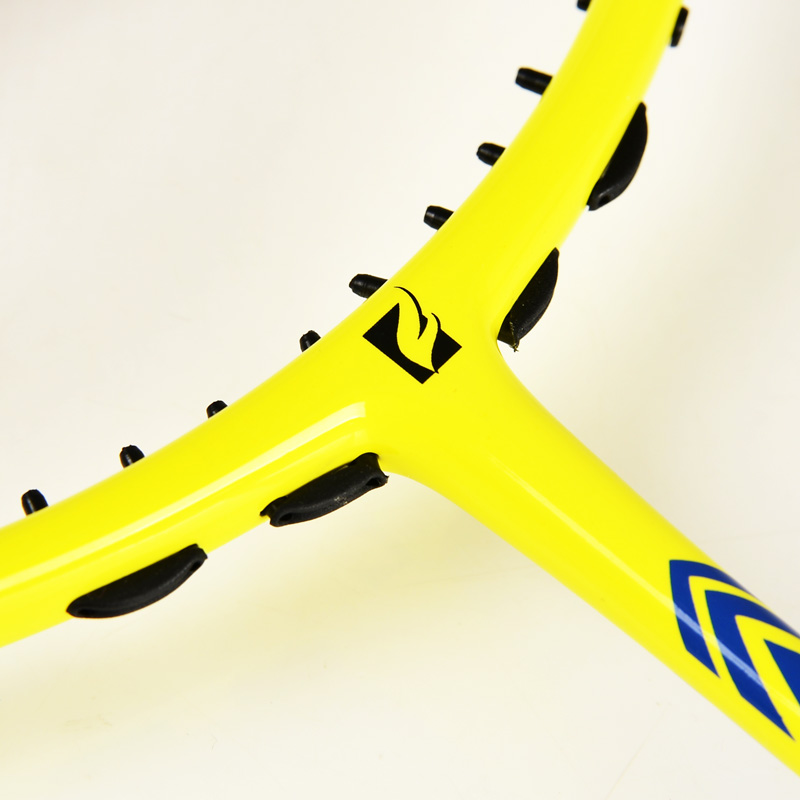
Setting the crosses two pounds lower compensates for that loss. It also protects the frame: a cross pulled to full tension against a fully tensioned main bed puts a compressive load on the head that the frame was not designed for, and the visible result is a head that shortens slightly — a phenomenon stringers call the frame losing its shape.
The consequence of ignoring it
A frame strung at 26/26 comes out feeling tighter than 26 and slightly compressed. The player reads that as a board-like string bed with no pocketing, and concludes the string is bad. Nothing in that conclusion is true, but the string takes the blame, and the next order goes elsewhere.
This is one of the few places where a supplier can improve a customer’s experience without changing the product at all — by printing the recommended differential on the string pack or on the care card.
How big should the gap be
Two pounds, or roughly ten percent, is the working convention for badminton and the starting point for most frames. It is not a rule with a governing body behind it; it is an accumulated practice that suits the geometry of a badminton head. Squash and tennis frames follow the same logic with different magnitudes because the head shape and string count differ.
Where it changes is at the extremes. At very low tensions the differential matters less because the friction loss is proportionally smaller; at very high tensions the differential matters more, because the compressive load on the head becomes the limiting factor before the string does.
What this means for the products you buy
String selection interacts with the differential. A thin, elastic string at a high tension with a large differential feels very different from a thick, firm string at the same numbers, and the customer’s ability to describe what they want is limited. The practical answer is to reduce variables: sell one string per use case, and give one recommended tension range for the frame it goes into.
That is easier with a range that is already narrow. The BG66 covers players who want feel and a livelier bed; the BG95 covers players who break string and want durability. Recommending a differential of two pounds for both, and stating a tension ceiling tied to the frame, is a shop instruction that costs nothing and prevents a category of complaint that no warranty covers.
Swingweight: the number behind the pair
Static weight and balance describe where the mass is; swingweight describes how hard it is to move. A frame can be light and slow at the same time, which is why a player who tests two frames with identical printed specifications can prefer one immediately. For a range buyer, this explains returns that the specification sheet cannot.
Measuring swingweight needs a machine, so the practical answer is to sort frames by feel in the shop and to be honest that printed numbers describe only part of the experience.
What to tell the customer at the counter
Three sentences do most of the work. The frame’s total weight tells you how it feels to hold. The balance tells you how it feels to swing. The string bed tells you how it feels to hit. When those three are separated, a customer can describe what they dislike accurately, and an accurate description is what makes the second sale a good one.
Common mistakes on this specification
- Quoting one tension for both axes in a purchase order.
- Assuming the customer will not notice a two-pound difference.
- Recommendation printed on the string but not in the shop’s workflow.
- Using the frame’s maximum tension as the recommended tension.
- Blaming the string when the differential was the cause.
Each of these has the same cheap fix: write two numbers instead of one.
One last thing worth writing into the shop’s workflow: record the differential next to the tension on the frame tag. When the same customer comes back in six months, that tag is the only record of what was actually done, and reproducing a string job you cannot remember is how a good relationship quietly ends.