

String Storage: Heat, UV and the Reel That Went Dead
String is sold as a material and stored as a material, but it behaves like a perishable. It sits in a warehouse, then in a shop, then in a drawer behind a stringing machine, and at every stage it loses a little of the property it was bought for. The customer who says a reel has “gone dead” is usually describing something real.
What actually degrades
Synthetic string is a polymer under orientation. Its performance comes from the way the molecules are aligned during extrusion, and that alignment relaxes over time — faster with heat, faster with UV exposure, faster still when the string is coiled under tension and the coil is stored in a warm place.
The practical symptom is not breakage. A degraded string still holds tension reasonably well; it has lost elasticity, so it feels duller and transmits more shock, and it stops snapping back. That is exactly the complaint a player makes when they cannot explain the problem.
Reels versus sets
A 200-metre reel is cheaper per stringing than a set, and that saving is real only if the reel is consumed within its useful life. For a shop stringing twenty rackets a week it is; for a shop stringing two, a reel can sit for two years and the last third of it will be measurably worse than the first.
The right unit is a stocking decision, not a price decision. Estimate restrings per month, multiply by the metres per restring, and compare that to a realistic shelf life. If the answer is more than eighteen months, buy sets or split the reel with another shop.
Storage rules that actually get followed
The rules are short, which is why there is no excuse for not applying them: keep reels boxed rather than open on a shelf, keep them away from windows, keep them out of the car, and keep them off the floor of a room that heats up. Coils should be stored unloaded — a reel wound tight and left in a hot room is the worst case.
One more rule is worth printing: do not store string in the same cupboard as cleaning chemicals or solvents. Vapour exposure degrades the outer layers of a coil, and the effect is invisible until the string is strung.
Colour and shelf life
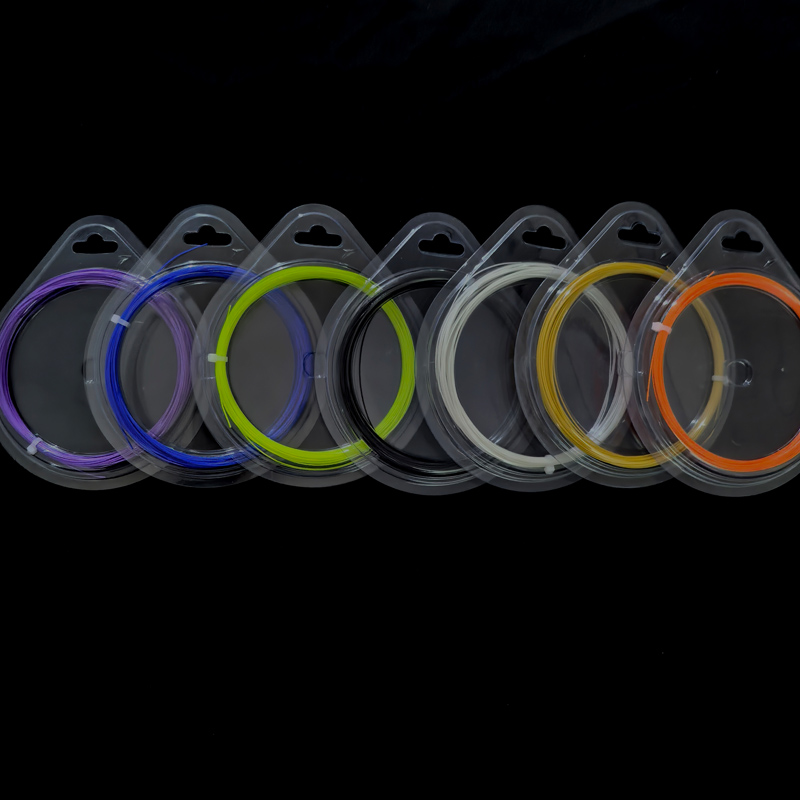
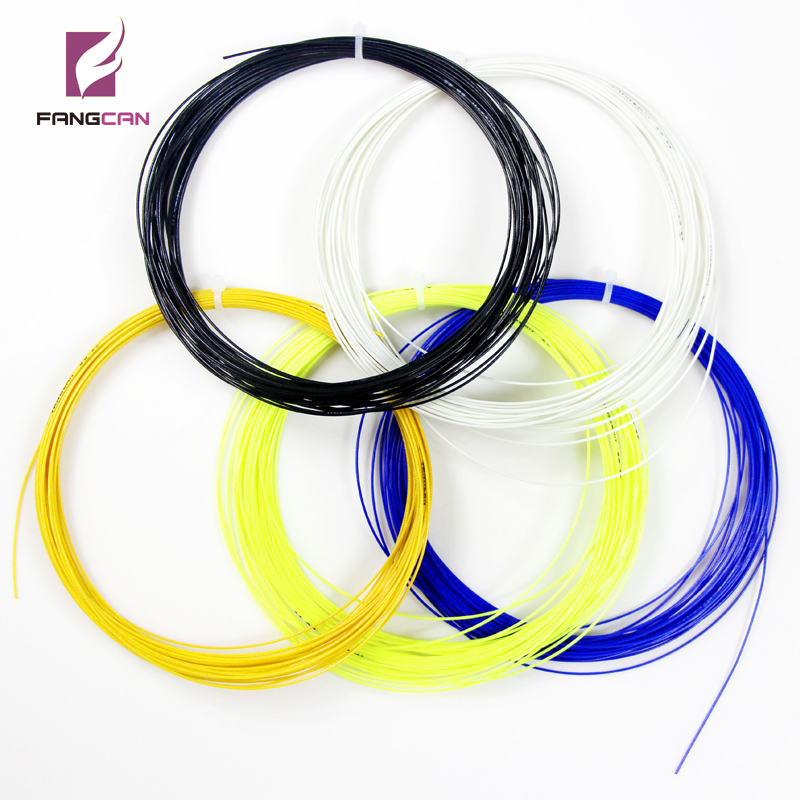
Pigmented string is not identical to natural string. Some pigments change the extrusion behaviour slightly, and pale colours show dirt and handling marks in a way that makes old stock look older than it is. If a colour has been on the shelf for two seasons, rotate it into the stringing machine rather than leaving it as retail stock.
What to specify when buying
- Production date on the reel or the box, not just the batch code.
- Recommended storage conditions, in writing.
- Reel length with a tolerance, and whether the length is measured under tension.
- Packaging that excludes light, since a clear bag does nothing.
- Colour fastness, if the colour is part of the product’s appeal.
For a range, the split that ages best is two or three gauges rather than many colours. The BG66 for feel and the BG95 for durability cover most of the demand, and both are bought often enough to turn over. Add colours only when a customer asks for them by name, and price the stock-keeping cost of that variety honestly.
The shop’s own stock rotation
Stock rotation is where string quality is actually lost. A reel opened two years ago and used occasionally is the usual culprit, not the supplier’s batch. Date the reel when it is opened, mark the box, and use the oldest first — three habits that cost nothing and remove most of the variability a shop attributes to the product.
Where a shop strings several gauges, keep the reels in a closed drawer rather than on an open shelf. Light is the second-largest factor after heat, and a drawer is cheaper than a light-proof bag.
When a reel should be retired
A reel that has stiffened, discoloured or started to kink at the coil should be retired rather than sold through. The test is simple: pull a length and let it hang. Fresh string falls into a soft curve; aged string holds a wave. That single check is faster than any discussion about dates.
Common mistakes on this specification
- Buying a reel based on price per stringing, not on turnover.
- Storing reels on an open shelf under a window.
- Accepting a batch code with no production date.
- Keeping string in the same cupboard as solvents.
- Assuming a sealed bag is light-proof when it is clear.
All five are storage behaviour, which means all five are within the buyer’s control.
Finally, treat string as a perishable in the accounts, not just in the storeroom: if the write-off is not visible, nobody rotates the stock.
The test takes ten seconds and settles the question: pull a metre out, let go, and watch whether it falls into a soft curve or holds a wave.