

Tennis Racket Weight and Balance: 270 g to 300 g
Tennis racket weight is quoted as a single figure, usually unstrung, and it is the least useful number on the sheet. Two frames at 285 grams can feel like different sports depending on where that mass sits, and a customer who buys on the figure alone will be back within a month, unable to explain what is wrong.
The useful description is a pair: static weight and balance point. Four combinations cover the market, and each one sells to a recognisably different player.
Where the mass sits
Balance is measured from the butt cap and expressed in millimetres. A frame at 320 mm is roughly even; 305 mm is head-light; 335 mm is head-heavy. Because the distance from the hand amplifies inertia, a head-heavy frame plays heavier than its static weight suggests, and a head-light frame plays lighter.
That relationship is what the four combinations describe, and it is the language a good shop should be using at the counter rather than a single number.

The four combinations
Light and head-light is the easiest frame to swing and the least stable against a heavy ball. It suits beginners and players with short, compact strokes who generate little racket-head speed of their own.
Light and head-heavy gives power from mass at the head without a heavy total. It is the classic beginner and senior configuration: the swing is easy, the ball goes further, and the frame is stable enough to be forgiving.
Heavy and head-light is the advanced configuration. Mass in the handle makes it manoeuvrable at the net despite a high static weight, and the player supplies the power. It rewards timing and punishes late contact.
Heavy and head-heavy is the plow-through frame. It is stable, it absorbs pace, and it is tiring over three sets. It sells to strong baseliners and to players who have already decided what they want.
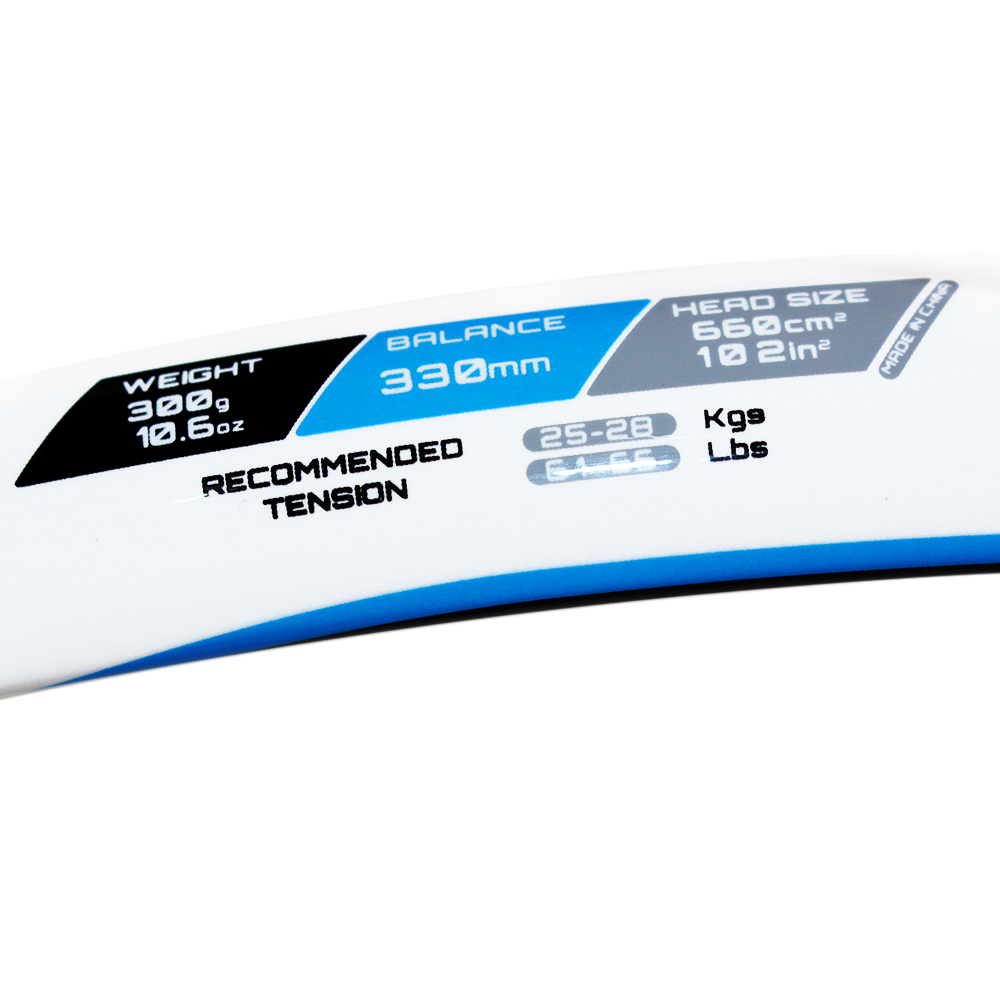
Why stratification matters commercially
A range built on weight alone produces two frames that look different and play the same, or the reverse. A range built on the two axes produces four products from two moulds and a handle-weight change, which is cheaper to make and easier to explain.
It also reduces returns, and the mechanism is worth stating plainly: a customer who is sold “light” and gets head-heavy will complain about control, and a customer sold “heavy” who gets head-light will complain about power. Both complaints are about the axis that was never discussed.
Strings move the balance
Stringing adds fifteen to twenty grams, and grip changes move it again. A frame specified at 320 mm unstrung will sit nearer 325 mm strung, and an overgrip shifts it back a couple of millimetres. That is why the specification has to state the state — and why a shop that measures a customer’s frame after stringing gets a number that means something for the next order.
What to put on the purchase order
- Unstrung weight with tolerance, and balance point in millimetres from the butt cap.
- Grip sizes offered, since grip mass varies with size.
- Beam width, which affects stability independently of weight.
- String pattern, because it changes the swing response at the same weight.
- Whether the frame ships strung, and with what.
For a first range, two frames on opposite corners of the matrix teach more than four in a line. The A8 and the A6 share a construction family and differ in specification; selling them as two answers rather than two prices is the difference between a range and a list.
And when a frame comes back, the diagnosis starts from the matrix. “Too heavy” from a player with a compact swing is a balance problem, not a weight problem, and the grading should separate the two before any replacement is promised.
The grip as a tuning variable
Grip size changes balance more than most buyers expect, because a larger grip adds mass at the handle end and shifts the balance point back by a couple of millimetres. That is usually a good thing for a head-heavy frame and a bad thing for a head-light one, and it is invisible if the specification only states one grip size.
Offering two grip sizes per model is not just a fitting service; it is a way to sell one frame to two different players without a second SKU.
Strings as a second tuning step
String choice moves feel considerably at the same weight and balance. A firm polyester at high tension makes a light frame feel harsh; a softer string at lower tension makes the same frame feel forgiving. Shops that treat string as a separate decision are effectively selling a third product, and the customer experiences it as service rather than as an upsell.
Common mistakes on this specification
- Listing weight only, without balance.
- Comparing a strung frame’s balance to an unstrung figure.
- Offering one grip size and calling the range complete.
- Assuming oversize automatically means light.
- Ignoring beam width when explaining stability.
Together these five account for most of the “it feels wrong” returns in this category.
If the shop can only measure one thing, measure the balance. It predicts feel more reliably than static weight, and it is the number a customer can be taught to describe.