

String Colour: What the Dye Changes and What It Does Not
A buyer asks for the string in blue and the supplier says yes, and both sides assume nothing has changed except the look. That is mostly true, and the exceptions are worth knowing, because they are the ones that generate complaints about a product that was never altered.
The useful distinction is between what the pigment does inside the filament and what the coating does on the outside. Only the second has a consistent effect on play.
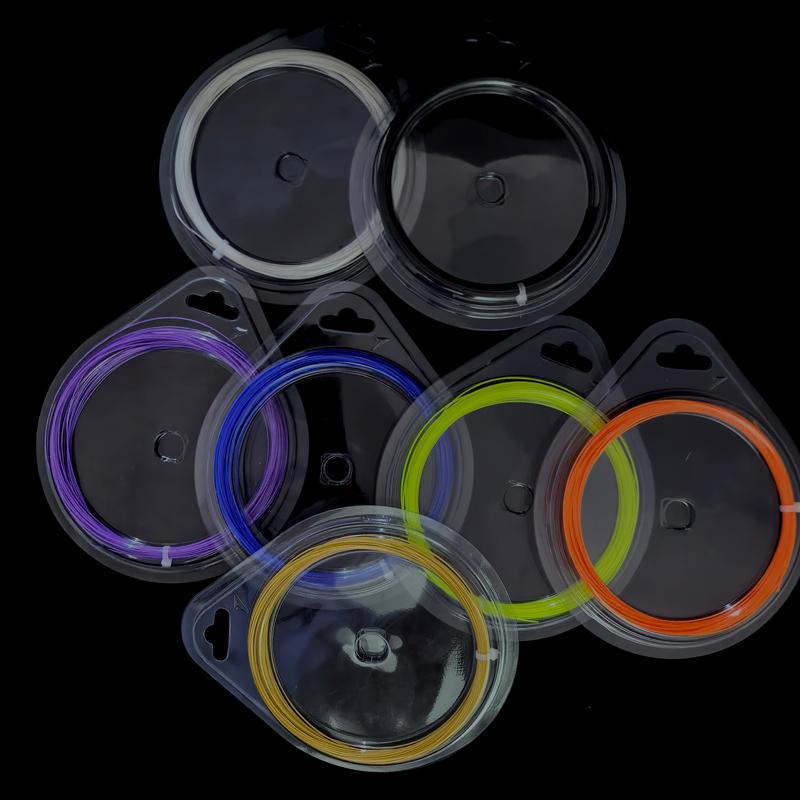
How colour gets into a string
Coloured strings are usually dope-dyed: pigment is added to the polymer before extrusion, so the colour runs through the filament rather than sitting on it. This is more durable than surface dyeing and does not change the diameter, which is why it is the standard method for monofilaments.
Multifilaments are harder. The core filaments may be dyed, and the wraps may be dyed separately, so a colour that looks uniform on the reel can be made of two different processes. That matters when a buyer wants a specific shade across several constructions.
What the pigment does to the polymer
Pigments are fillers, and any filler changes the polymer slightly: it can raise stiffness, reduce elongation or alter how the material fatigues. At the loadings used for string, the effect is small, typically below the difference between two gauges, but it is not zero, and it moves in different directions for different colours.
White and natural strings avoid pigment altogether, which is part of why they are often the reference product for a construction. A buyer comparing a white and a black version of the same string is not comparing the same object, even if the specification sheet says so.
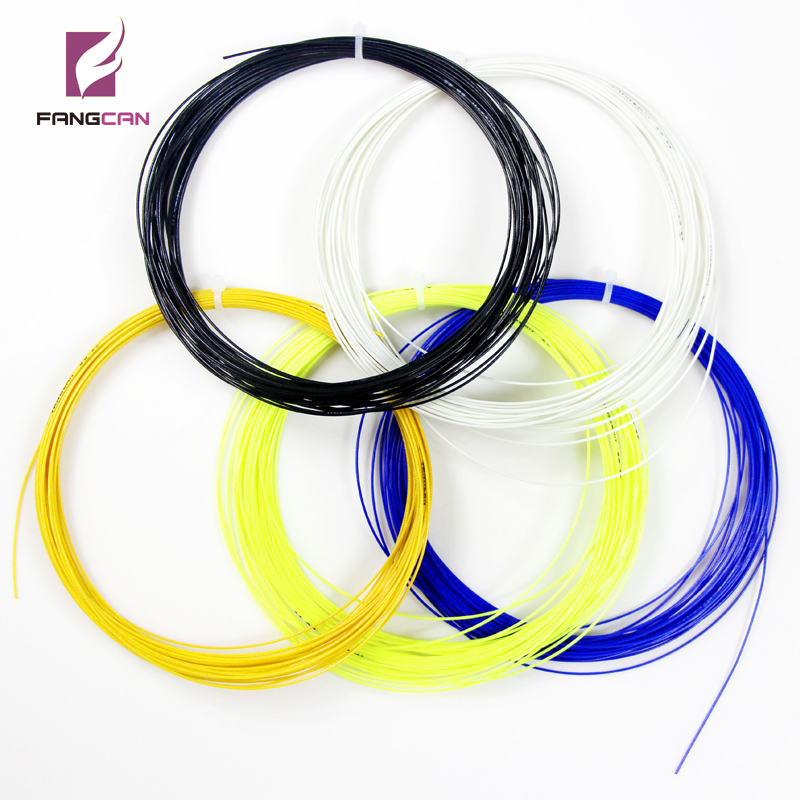
The coating is where the real difference sits
Coatings are formulated for friction, and the additives that create a slippery surface do not always behave the same way once a pigment is present. A manufacturer that changes colour without re-validating the coating may deliver a string that notches differently, which the player experiences as “these break faster than they used to”.
This is the practical rule: colour changes are cheap on paper and expensive in a workshop, and a supplier that can say which colours share a coating formulation is telling you something about how its line is set up.
Where colour is purely perception
Most of the commercial value of colour is not in play at all.
A coloured string lets a brand match a frame, a grip and a bag into a coherent set, and it lets a shop merchandise a wall that customers choose from by eye. That is a legitimate product decision, not a gimmick.
The cross-colour squash string is an example of colour doing exactly this job: two colours in one string, chosen so the bed reads as a pattern rather than as a single tone. Nothing about the construction has to change to achieve it.
Fastness and the parts that touch it
- Colour fastness on wet rubbing, since a sweaty hand contacts the grip, not the string.
- Whether the coating is clear or tinted, because tinted coatings wear visibly.
- Shade consistency between production batches, with a tolerance.
- Whether white grips and light-coloured bags will pick up transferred dye.
- The light source used for approval, since shop lighting varies.
The fourth item is the sleeper. A dark string in a humid bag can transfer colour to a light grip, and the customer will describe it as a defect in the grip. Pairing a coloured string with a light overgrip is a merchandising decision with a quality consequence.
What to write in the order
Colour should be specified the way any other appearance attribute is specified: a physical standard, a tolerance, and the conditions under which it is judged. “Blue” is a category; a chip is a specification.
Storage belongs in the same conversation, because a coloured string left in a hot shop changes in ways that look like a colour problem and are actually an ageing one, the mechanism described in this note on storage. A string that has yellowed in stock will not match a fresh reel, and no amount of colour matching in the order will fix it.
Matching a range without re-engineering it
The clean way to add colour to an existing line is to keep the construction and change only the dye lot, then verify the two things that can move: gauge and surface friction. Gauge is measurable with a micrometer on a sample of ten; friction is checked by pulling a length through a defined tension and comparing the force curve against the reference colour.
If both are inside tolerance, the new colour can be released without a full re-validation. If either moves, the colour has become a different product, and the honest options are to adjust the construction back or to sell it as a variant with its own specification.
What a supplier should never do is change the colour and keep the old specification sheet. That is how a brand ends up with two years of customer data from two different strings, and no way to explain why the second year behaves differently.
The short version for a buyer: change colour freely if you are matching a range, but re-validate before you change it on a string that customers already trust. The pigment is quiet; the coating is not.