

Adding Weight: Tungsten Tape, Lead, and Where Three Grams Go
Weighting a racket is the cheapest customisation in the sport and the one most often done by feel, with no record kept. A shop adds three grams to a frame, the player likes it, and nobody writes down where those three grams went — which means the next frame cannot be built the same way.
For a buyer or a brand, the useful discipline is simpler than the physics: decide the position, state the mass, and record both.

Why the position matters more than the amount
Adding mass anywhere increases static weight equally. Adding it at the head increases swing weight, because swing weight is the moment of inertia about an axis near the handle and head mass sits far from that axis. Three grams at twelve o’clock can add as much swing weight as fifteen grams in the handle.
So the first decision is not “how much” but “what do I want to change”: more plough-through at contact, more stability against twist, or a different balance with the same swing weight.
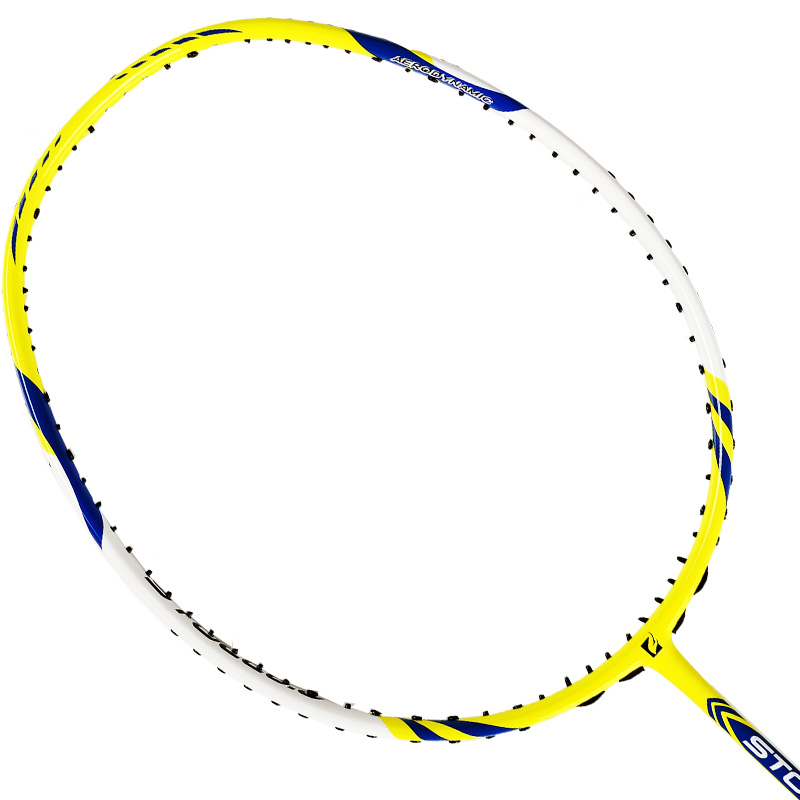
What each position does
Twelve o’clock raises swing weight the most per gram and moves the balance towards the head. It makes the frame hit heavier and swing slower. It is the placement for a player who wants the frame to do more of the work.
Three and nine o’clock raises twist weight — resistance to the frame rotating when the ball is struck off-centre. This is the placement for a player whose mishits twist the frame in the hand, and it costs less swing weight per gram than twelve o’clock.
Handle and butt cap adds static weight while barely changing swing weight, and moves the balance towards the hand. This is how a frame gets more stable without becoming slower.
Tungsten or lead
Tungsten is about 19.3 g/cm³ against lead’s 11.3, so the same mass in tungsten takes up less than two-thirds of the volume. On a modern frame with a thin beam, that matters: a strip of lead thick enough to hit the target mass will sit proud of the frame and can foul the string or the paint. Tungsten tape in the same position stays flatter and is less likely to be knocked off.
Lead is cheaper and easier to cut. For shop-level tuning that is fine. For anything that ships to a customer as a finished product, tungsten is the more defensible choice, because the strip is thinner and the adhesive has less lever arm to peel against.
The tolerance trap
A frame ordered at 85 g ±2 g already varies by four grams across a batch. Adding three grams of tape to a light frame and three grams to a heavy frame produces two frames that are no longer the same product — and the tape has made the variation visible rather than caused it.
This is the point where weighting and batch tolerance have to be discussed together, and it is why swing weight rather than static weight is the number worth recording after the modification.
What a spec sheet should carry
- Base frame mass and balance, measured before any weighting.
- Position of any added mass, described by clock position and distance from the butt cap.
- Mass added, per position, in grams.
- Resulting balance point, measured after weighting.
- Adhesive type on the strip, and whether it is intended to be permanent.
The second item is the one that makes a customisation repeatable. “Three grams at the top” is not a specification; “3 g at 12 o’clock, 660 mm from the butt cap” is.
Where this belongs in a range
For a brand, weighting is a way to extend a mould rather than add one. A single frame can be offered at two swing weights by fitting or omitting a strip, which gives a distributor two SKUs from one tool — a legitimate use of the technique, as long as the difference is measured and documented rather than guessed at the counter.
STORM 90 and the N9 already sit at different points on that axis out of the box, which is why a shop should be careful about adding tape to either without measuring first. Adding weight to a frame that was already head-heavy is how a good racket becomes a sluggish one.
Taking weight off again
Weighting is reversible in principle and not always in practice. Adhesive residue pulls paint when the strip is removed, and a strip left on for a season cures harder than one removed after a week. On a matte finish the mark is usually invisible; on a thin gloss coat it can leave a patch that no polish will match.
That is worth telling a customer before the strip goes on, and worth specifying when a brand ships pre-weighted frames: use a removable adhesive, and say so on the card. A frame that cannot be returned to stock weight is a frame with a narrower resale market.
Tournament rules do not prohibit adding weight; they require the finished racket to remain within the frame’s stated limits.
The rule that keeps this honest is short: measure before, measure after, write both down. Three grams is a small number only until nobody can reproduce it.