

76, 80, 88 Holes: What the Hole Count Actually Changes
Hole count appears in more catalogues than it used to, usually as a bare number next to the string pattern. It is rarely explained, and it is one of the few frame specifications that changes what happens to the string rather than how the frame looks.
The useful question is not how many holes a frame has. It is how many of those holes are shared, because a shared hole is where two strings pull against each other through one piece of plastic.
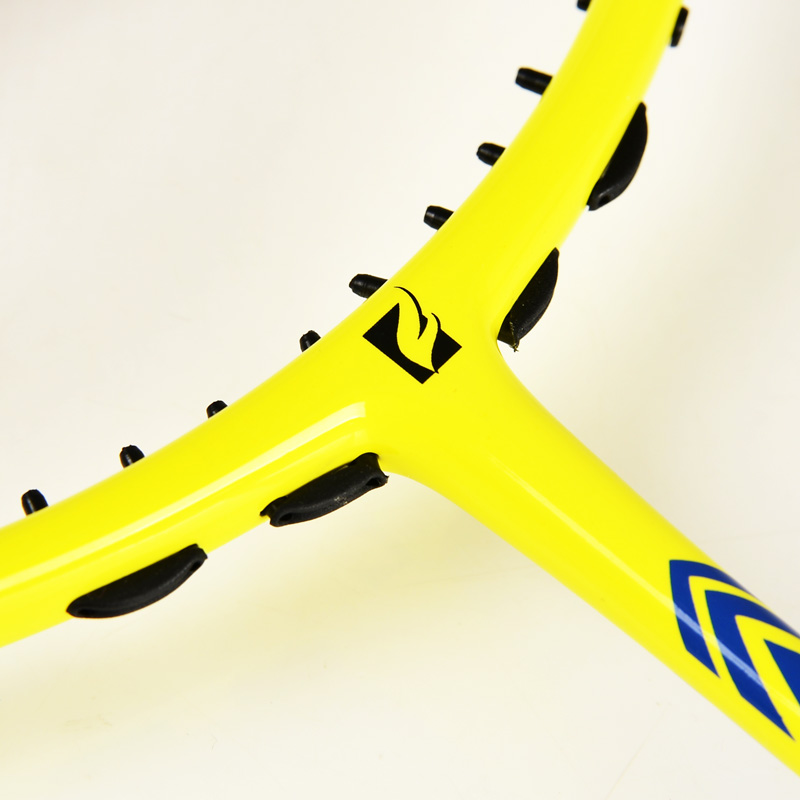
What a hole is, physically
Each hole in a frame is lined with a grommet — a small plastic tube that protects the string from the carbon edge and spreads the load over a wider area. A dedicated hole carries one string. A shared hole carries two: one main and one cross passing through the same tube, crossing each other just outside the frame.
Every frame needs a certain number of holes for the pattern to exist. Everything above that minimum is a choice about how much sharing to accept.
More holes means less sharing
A frame with more holes can give most strings their own grommet, which means less rubbing at the exit point and less interference between main and cross tension. A frame with fewer holes routes more strings through shared tubes, which is lighter and cheaper to produce but concentrates wear in a smaller number of places.
That is the whole trade. The number changes nothing about how the frame looks and everything about where the string will eventually fail.
Why string life is the visible symptom
Friction at the grommet is what cuts string. In a shared hole, two tensions meet at one point and the string moves slightly on every impact; the plastic wears, the edge of the hole becomes sharp, and the string fails at that spot repeatedly.
This is why the complaint is specific rather than general. A customer does not report “short string life”; they report breaking in the same place every three weeks. That pattern is a hole-routing story, which is why break location is a diagnostic before it is a warranty case.
What it does to tension and feel
With less sharing, tension distributes more evenly across the bed and the string bed holds its figure longer. With more sharing, the mains and crosses interfere at each shared point, which tends to make the bed feel slightly firmer at the edges and softer in the middle, and to accelerate tension loss in the areas with the most sharing.
None of this makes fewer holes worse. It makes it different, and it makes the difference predictable — which is what a buyer needs in order to price a frame against the cost of restringing it.
Drilling is a strength question too
Holes remove material from the most highly stressed part of the frame. A frame designed for a high hole count has wall thickness and layup specified around those holes; a frame with extra holes drilled into a layup designed for fewer is a different and weaker product.
This matters when comparing two suppliers quoting the same model name. The count is easy to copy from a catalogue. The layup behind it is not.
What to put on the spec sheet
- Total hole count, and how many of them are shared.
- String pattern as mains × crosses, separately from hole count.
- Grommet specification: material, and whether the set is replaceable as a kit.
- Recommended tension band for that frame, not only the frame maximum.
- The string and tension used during the frame’s own validation testing.
Replaceable grommet sets are the cheapest quality signal on that list. A frame whose grommets can be renewed has a second life; a frame with moulded-in tubes is a one-life product, and the buyer inherits that.
How it plays out in a range
Two frames from the same mould family can be positioned on this axis honestly: one with more sharing for a price-led line, one with less for a line sold to players who restring monthly. STORM 90 and CC6.0 can be presented that way without either being described as the cheap option.
The cost per month, not the cost per frame
Hole routing changes restringing frequency, and restringing frequency is a line item a club can measure. A frame that breaks string every three weeks costs 17 restrings a year; one that lasts six weeks costs 9. At a typical shop rate, that gap is larger than the price difference between a mid-range and an entry frame.
This is the argument that sells the better-routed frame, and it only works if the buyer knows the mechanism. Presented as “better quality” it sounds like marketing; presented as “fewer restrings” it becomes arithmetic the club treasurer can check.
Grommet kits are also the cheapest spare part a distributor can stock. A bag of tubes costs less than a restring and turns a frame with a worn hole back into a usable one.
The question to ask a new supplier is simple: how many of the holes are shared, and which ones. A factory that can answer with a routing diagram is a factory that has thought about where its frames break.