

Overgrip Winding Geometry: 1100 mm Is Tighter Than You Think
Overgrips are sold by the piece. Buyers should be planning by racket-years. Between those two units sits a conversion nobody runs: how many turns one grip gives, how much handle it covers, how many pieces a racket consumes in a year. All three are computable from the spec, and the spec is three numbers.
Length, width, thickness: each governs a different thing
Our grips are specified as length × width × thickness — FCOG-02 is 1100 × 25 × 0.8 mm. The three are not parallel fields. Each answers a separate question.
Length decides whether it reaches. It is the only parameter that is fatal when short. A grip that will not cover the handle has no remedy.
Width sets turn count and pace. A wider strip advances further per turn, needs fewer turns, wraps faster — but the overlap lines run sparser and the finished feel is looser.
Thickness sets circumference gain. This is the only one of the three that changes feel: one layer at 0.8 mm adds roughly 5.0 mm of circumference, while one layer at 1.9 mm adds about 11.9 mm.
So “all 1100 × 25 × 0.8” is no reason to treat products as identical. Within our own 0.8 mm band sit FCOG-02, FCOG-03, FCOG-06, FCLG-02, FCLG-07 and FCLG-08, with lengths between 1090 and 1140 mm and widths between 25 and 26 mm. Multiplied by turn count, those millimetres decide whether one piece finishes the job.
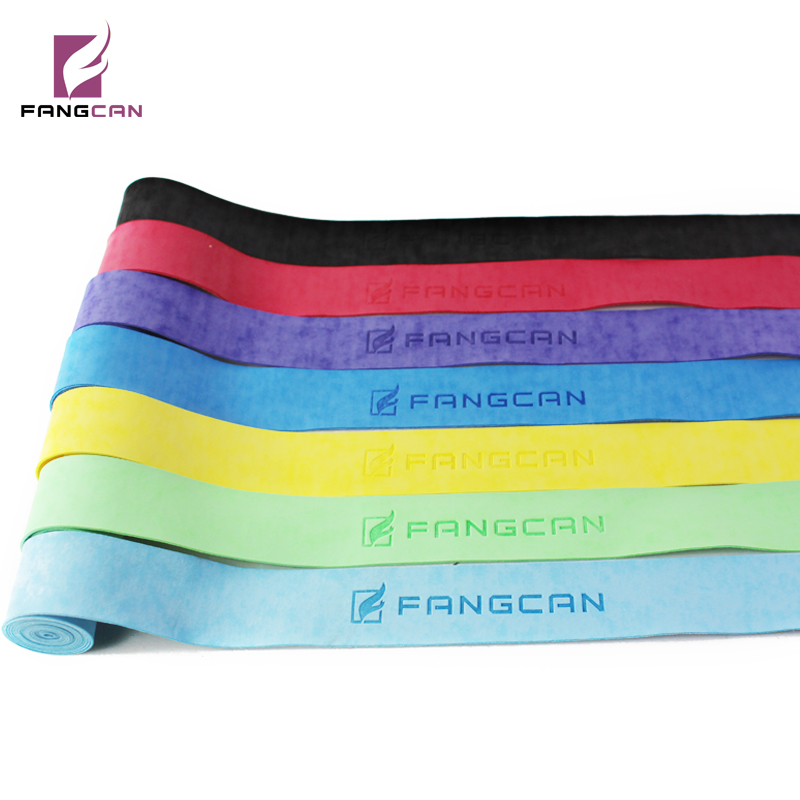
The arithmetic: does 1100 mm actually cover a handle?
A standard badminton handle runs about 200 mm. When wrapping, each turn overlaps the previous one — the convention is roughly 40% overlap, so each turn advances about 60% of the strip width.
At 25 mm wide, that is about 15 mm of advance per turn. 200 ÷ 15 ≈ 13.3 turns.
Each turn consumes one handle circumference. A G3 badminton handle measures 85–90 mm around, so take 87 mm: 13.3 × 87 ≈ 1157 mm.
Two things follow.
First, 1100 mm is tight. The theory says it falls about 50 mm short; in practice it finishes because the base is usually wrapped without overlap and the top is stretched thin. The margin is small, and a looser wrap runs out.
Second, that explains why 1130 and 1140 mm exist. FCLG-01 and FCLG-04 are 1130 mm; FCOG-09 is 1140 mm. The extra 30–40 mm is finishing margin and tolerance, not a random figure.
The 1500 × 35 × 1.5 mm FCOG-10 is a different animal. At 35 mm wide, each turn advances about 21 mm, so 200 mm needs only ~9.5 turns and roughly 830 mm of strip. The remainder is headroom for longer handles — tennis frames are longer, and the listing covers fishing rods, tennis, badminton and squash for exactly this reason.
Wider is not better
The width trade-off is blunt.
25 mm is the badminton standard. More turns, tighter fit, continuous feel. A racket takes about thirteen turns — slower to fit, better result.
26 mm is slightly wider. FCLG-06, FCLG-07 and FCLG-08 all sit at 26 mm, one turn fewer, faster to fit. All three are keel models, such as the FCLG-01, where the extra millimetre evens out ridge spacing.
35 mm is wide-format. Right for long handles and large diameters; on a badminton frame the overlap goes too sparse and the grip feels hollow.
For buying, width must be tied to category, not standardised: 25 mm badminton, 35 mm tennis and fishing rods, 26 mm keel models covers almost everything.
Backing adhesive: an underrated structural difference
Grips come with or without a backing adhesive, and the spec usually reduces this to three characters.
With adhesive, the starting end sticks to the butt, so you do not have to hold it down while wrapping. Faster, and tidy even in inexperienced hands. The cost is residue on removal, plus a position that cannot easily be adjusted once stuck.
Without adhesive, the wrap self-locks under tension and is finished with tape. It demands consistent tension while wrapping, but allows repositioning and leaves nothing behind.
Which depends on the customer: adhesive suits end consumers; unbacked suits stringing shops and clubs, who adjust repeatedly and will not clean residue. Worth its own RFQ line — at the same price it is the first thing silently substituted.
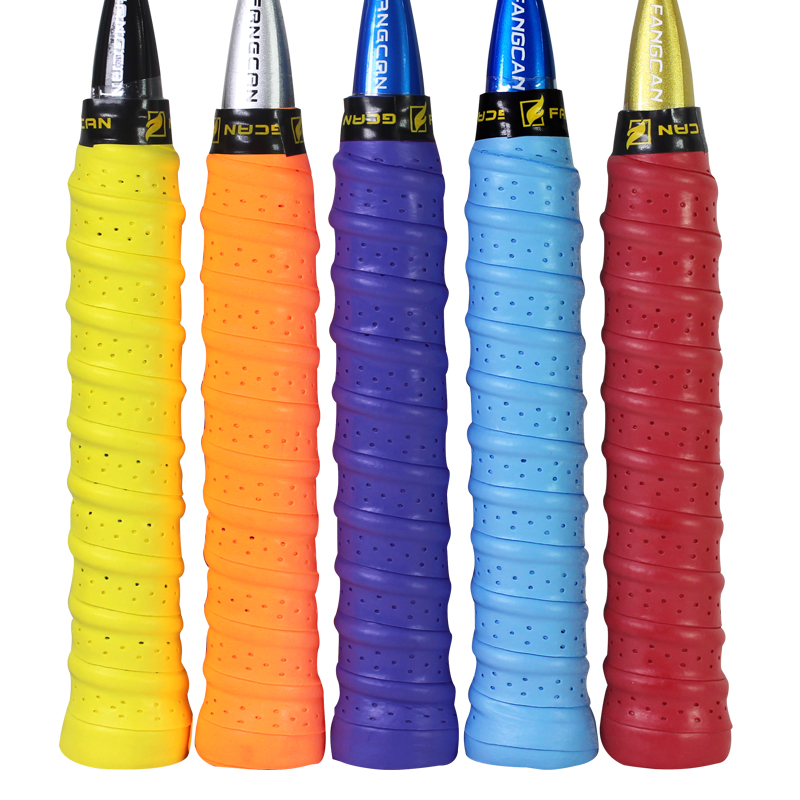
Keel direction: the most common complaint
A keel grip carries a raised ridge along its surface, there to give the fingers a locating channel. Whether that works depends entirely on wrap direction.
The correct direction is the ridge running along the advance of the wrap, so fingers fall into the channels between ridges. Wrap it the other way and the ridge lies across the fingers, digging in — and the harder you hold, the worse it gets.
This is an assembly fault, not a quality fault, but the complaint arrives labelled as quality. Our FCLG series includes single-colour and dual-colour versions (FCLG-07, FCLG-08), and on dual-colour the ridge reads more strongly, so a reversed wrap is more obvious.
The fix is nearly free: print a direction diagram on the packaging or the listing. One small graphic removes most of these complaints, and today most grip packaging carries nothing at all.
How to size the buy
Overgrips are a high-frequency consumable, so quantities work nothing like capital goods. Four steps, in racket-years.
One: fix the replacement rate. Frequent players change often; casual players two or three times a year. Only the customer can supply this number — do not assume it.
Two: fix how many rackets one piece covers. A standard badminton handle takes one piece. A 1500 mm strip can be cut into two short-handle pieces, and where cutting is acceptable the unit cost actually falls.
Three: stock by width, not by colour first. 25 mm and 26 mm are not interchangeable; stocking both without segmenting creates dead inventory.
Four: treat colour as SKU multiplication. Individual models run five to eleven colours. Stocking them all multiplies SKU count several times over. Cut to skin tone, black, and one or two brights.
In one line: the grip spec is three numbers, but each one drives a different buying decision — length for reach, width for category, thickness for feel. Read them separately and the comparison finally means something.