

Balance Point Needs a Length: 290 mm Is Not 290 mm
Balance point 290 mm or 380 mm — which is more head-heavy?
Most people would answer 380 without thinking. But if one figure comes from a badminton racket and the other from a squash racket, the answer collapses. A badminton frame is 675 mm long, so a 290 mm balance sits at 43% of total length. A squash frame is 685 mm, so 380 mm reaches 55%. The first is handle-biased, the second clearly head-biased, and the raw numbers show none of that.
This is the standard misreading of the balance column: it is a length, and it only means something next to total length.
Pin the definition first
Balance point is the position of the racket’s centre of gravity, measured from the butt of the handle, in millimetres.
It is therefore an absolute position, not a ratio. Two rackets of different length can have their balance figures compared directly, but the meaning cannot. The only way to compare across categories or lengths is to divide balance by total length and convert to a percentage.
Run our own range through that conversion and the pattern appears immediately.
| Category / model | Balance | Length | Ratio |
|---|---|---|---|
| Badminton · steel frame, carbon shaft | 280±10 mm | 670±5 mm | 41.8% |
| Badminton · STORM CC6.0 | 285–295 mm | 675±2 mm | 42.2–43.7% |
| Badminton · THRUSTER K15 | 295±5 mm | 675±2 mm | 43.7% |
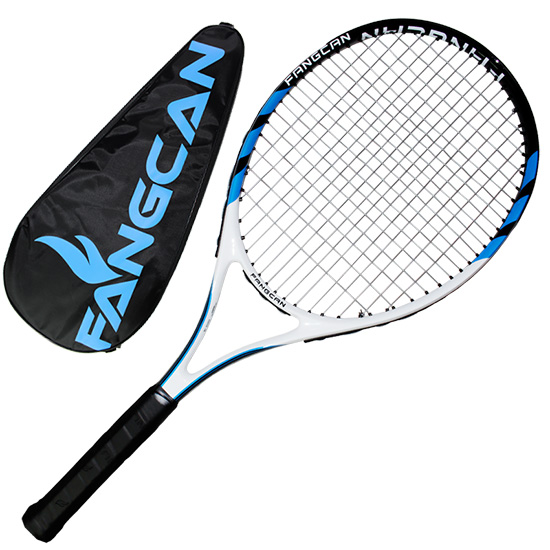
| Tennis · SUPER A8 | 330±5 mm | 27 in ≈ 686 mm | 48.1% |
| Squash · FCSQ-01 | 335±7 mm | 685±5 mm | 48.9% |
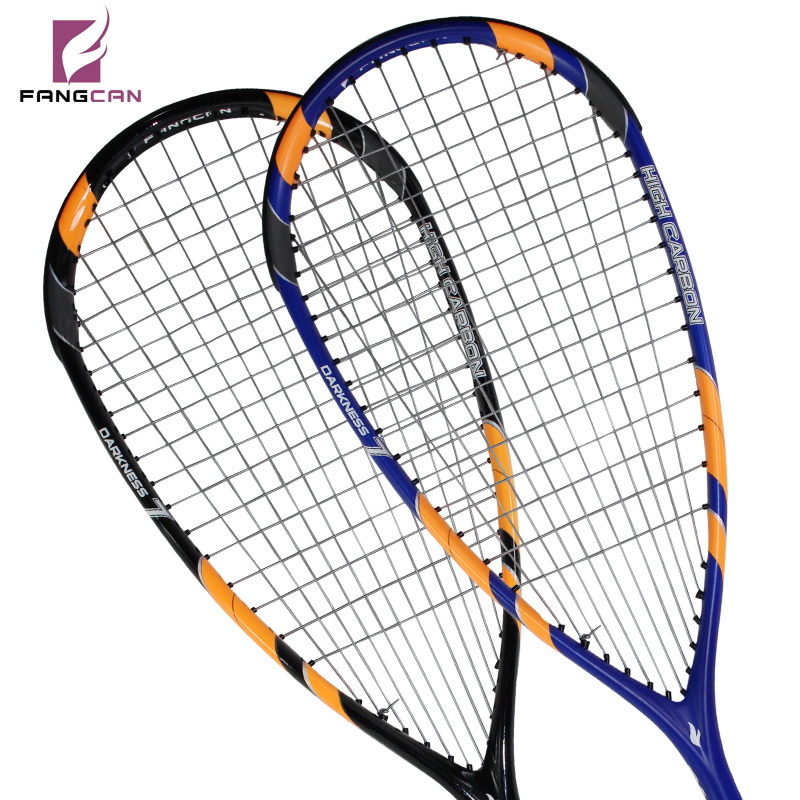
| Squash · DARKNESS 7 | 365±5 mm | 685±5 mm | 53.3% |
| Squash · SILVER 130 | 380±4 mm | 685±5 mm | 55.5% |
After conversion the trend is clean: badminton clusters at 42–44%, tennis and entry squash at 48–49%, advanced squash at 53–56%.
Why badminton sits lowest
This is not a manufacturing difference. It is what each sport asks of the frame.
Badminton is fast and rally-dense, and the shot depends on swing speed rather than head mass. A lighter head means less rotational inertia, so the wrist and forearm can accelerate it to high speed within a short arc. A low-ratio frame swings head-light and stays manageable across repeated fast exchanges.
Squash inverts this. The court is small, the ball is heavy and loses speed quickly, and the shot relies on the inertia of the head pressing into the ball. A high-ratio frame gives a heavy head that hits hard, at the cost of fatigue over long rallies. The weight bands differ as a result — our DARKNESS 7 is 145 g full carbon at 53.3%, while the FCSQ-01 is a 230 g aluminium-carbon composite at 48.9%. Two routes within one category: light and quick against heavy and stable.
Absolute within a category, ratio across categories
The rule is practical because the two comparisons answer different questions.
Within a category, absolute millimetres are enough. Badminton runs from 285 to 295 mm, a spread of 1.9 percentage points, and that already separates distinct feels — the defensive and attacking divide is usually drawn near 290 mm. Squash runs 335 to 380, a 6.6 point spread, which is not a tuning difference but two different instruments that almost no single player can drive equally.
So compare millimetres inside a category — but watch where the tolerance sits. STORM CC6.0 states 285–295 mm, a 10 mm band. THRUSTER K15 states 295±5 mm, also a 10 mm band. One gives a range, one gives a centre; control precision is identical, but only the second tells you the target. Standardise the notation at quotation or the comparison is meaningless.
Across categories, convert to a ratio. Comparing badminton’s 290 mm with squash’s 365 mm produces the right conclusion by the wrong method, because the lengths differ. Converted to a ratio, the conclusion becomes transferable — which is what you need when placing a new category, such as pickleball, into an existing range.
The condition that must travel with it
Balance changes once the frame is strung. Fifteen to twenty grams of string sit concentrated in the head region, and the centre of gravity moves toward it. The shift is a few millimetres — exactly the size of the tolerance band.
Our own labelling is inconsistent. SUPER A8 states “balance (unstrung) 330±5 mm”, which is the correct form. Most badminton frames simply say “balance 285–295 mm” with no indication of strung or unstrung.
That gap is dangerous in use. If supplier A quotes unstrung and supplier B quotes strung, identical frames will feel different to the same player, and the difference gets attributed to quality. So the field must read “balance (unstrung)”, written in the same bracket as the weight basis.
Pickleball exposes a more basic problem
Pickleball deserves its own paragraph. Our JP25 and JP26 state a balance point (225±10 mm and 230±10 mm) but no total length. Two other paddles in the range state total length (400 mm and 420 mm) but no balance point.
The result: no single unit can produce a ratio. 225 mm on a 400 mm paddle is 56%; on a 420 mm paddle it is 54%. Two percentage points is precisely the boundary between head-heavy and even.
This is not one supplier’s failing but an industry convention: balance and length are treated as separate fields, each filled or skipped independently. In reality they are one pair, and one without the other is inert. The fix at buying level is small — put both on one line of the RFQ and require both, incomplete if either is missing.
How to use this column
Four actions, all of which land directly on the quotation sheet.
Force “(unstrung)” after every balance figure. Write it in the same bracket as the weight basis.
Add total length. Even where it looks fixed — 675 for badminton, 685 for squash — write it, because the tolerance differs.
Compute the ratio yourself. Take the two numbers, divide, and record it in the selection sheet. That single step puts different categories on one chart, which is the cheapest selection tool available.
Compare millimetres within a category, percentages across. Not the reverse.
In one line: balance is a position, not a personality. The position needs length before it can be read as one.